James Orrock and Sir J.C. Robinson: Connoisseurship of Turner's Shipwreck Paintings
JMW Turner: the source expertise clore national gallery expert opinion tate turner studies society news authentication christie’s sotheby’s


Orrock/ Robinson/ Griffith James Orrock R.I., R.O.I.[1] (1829-1913) the Victorian/Edwardian gentleman from whose collection JMW Turner’s Shipwreck, the Rescue sold at Christie’s in 1904, was a renowned collector of both paintings and Oriental ceramics and was himself a widely exhibited artist. In fact some of what has come down to us about Turner’s secreted working methods has done so by virtue of Orrock quoting his own painting master, W.L. Leitch. James Orrock: Photogravure - Walker E. Cockerell
Art World’s Dirty Little Secret
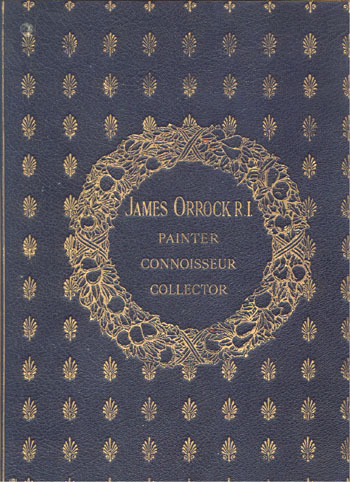 Orrock had been
21 years old on Turner’s passing, and was only 10 years younger than Turner’s
champion’ “Ruskin, who was “a frequent visitor” to
Orrock’s home at 48
Bedford Square.
Ruskin would
have had ample opportunity to study Shipwreck, the Rescue while
visiting. As was eventually discovered, there was an oversize
two-volume biography written about
Orrock by Byron Webber:
published in London, Chatto and Windus 1903:
James Orrock R.I.,
Painter, Connoisseur, Collector. Three artful publications
that Orrock illustrated
himself in the style of Turner are: Mary Queen of Scots; Old England
Orrock had been
21 years old on Turner’s passing, and was only 10 years younger than Turner’s
champion’ “Ruskin, who was “a frequent visitor” to
Orrock’s home at 48
Bedford Square.
Ruskin would
have had ample opportunity to study Shipwreck, the Rescue while
visiting. As was eventually discovered, there was an oversize
two-volume biography written about
Orrock by Byron Webber:
published in London, Chatto and Windus 1903:
James Orrock R.I.,
Painter, Connoisseur, Collector. Three artful publications
that Orrock illustrated
himself in the style of Turner are: Mary Queen of Scots; Old England
- her story mirrored in her scenes, 1908; and, In the Border Country,
Of the acknowledgements deemed necessary by Charles Holme in the classic 1903 The Studio publication: The Genius of J.M.W. Turner R.A., Orrock is highlighted along with a scant few other irreproachable Turner advocates. Well acquainted with Turner through his painting master and very knowledgeable about his art in general, Orrock had written extensively about the artist and collected some of his most famous works, including; Rockets and Blue Lights, and Walton Bridges. He was the same age as Walter Thornbury (1828-1876), Turner’s first biographer, and was older than all subsequent Turner biographers. He had substantial influence over several important collectors of the day; one of the more important, to quote Sotheby’s was “The greatest connoisseur of British Art,” Lord Leverhulme (see also Sotheby’s sale “The emphasis of Leverhulme’s collecting shifted in 1896 on meeting James Orrock - a major collector of English art.”) There should be no argument that as an artist, renowned collector and foremost advocate of Turner and British art generally, Orrock must be considered a premier Turner Connoisseur and expert’ “more so than even his first biographers or subsequent biographers who all missed the mark on at least one level. The other broadly experienced colleague at the time was Ruskin. In addition to Orrock’s pre-eminent qualifications; Ruskin had met Turner personally… Manna from heaven, it was a surprise to discover The Wreck in the Orrock biography.

James Orrock R.I., R.O.I., the original is an oil painting J.M.W. Turner’s influence on Orrock is quite apparent in this print by W.E. Cockerell
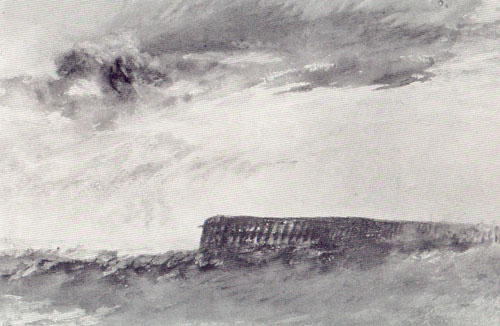 Sea
Breaking on a Pier; J.M.W. Turner, w/c
Orrock had acquired
Shipwreck, the Rescue from
Sir John Charles Robinson R.E.[2]
(1824-1913) the landscape painter and etcher. From 1879 until 1901, Sir
Charles held the venerable post of Surveyor of Her Majesty Queen Victoria’s
Pictures,[3]
and was highly respected for his understanding and appreciation of art
at an exemplary level. He served as the first Superintendent of Collections at
the South Kensington Museum (1852-1869) (later to be known as the Victoria and
Albert Museum).
Important to note here: “When the rooms in Marlborough House occupied by
Turner’s pictures and drawings were required for other purposes, the
Government decided to build a series of temporary galleries in connection with
the Museum at South Kensington.” (Finberg 1961, 447)
This 1858 establishment of what amounted to a makeshift “Turner Gallery,” was
in lieu of proper facilities as prescribed by Turner in his Bequest. It was
under Robinson’s aegis that this extensive collection of Turner’s work was
housed, protected, and displayed, while plans were still underway for a
permanent and exclusive facility to house the treasure trove of Turner’s work
(those hundreds of paintings and thousands of works on paper). Robinson would
have been the conductor of this extensive effort, and by association would
have been a
leading connoisseur of Turner’s work.
In addition, Robinson had been able to redirect the original intentions of
the V and A by making art a priority over the original utilitarian educational
resource that it was first meant to be.[4]
“He was in favour of filling the V and A with great works of art of no
utilitarian value whatever, and in accordance with this theory he bought
brilliantly when masterpieces were everywhere available.”[
i] He was responsible for acquiring important
drawings by Michelangelo for the British Museum.
[ii]
According to John Walker of the National Gallery of Washington, if it were
not for Robinson’s astute redirection of the V & A’s original collecting
intentions, the great museum would have succumbed to minimally instructive
“curatorial purchases” of little historic or cultural value.
And who exactly was the Surveyor of the Royal Collections? At the time,
Richard Redgrave, a leading authority within the art establishment and
Surveyor himself summed it up “in no uncertain terms, as early as 1867, that
the duties of the Surveyor involved artistic knowledge, sound judgment, and
experience,” and from Christopher Lloyd’s same publication: “The post of
Surveyor requires a rare combination of skills ’ " art historical, curatorial,
practical, courtly and administrative, for the Royal Collection is not only
one of the world’s great assemblages of pictures, but a working stock,
constantly required to furnish State and Private Apartments, and offices.”
[iii]
Robinson, as well as those more
obvious talents listed above, had the, ‘’’: practical skills’ deemed necessary for
the job; he was “an active collector much involved with buying and selling.”
[iv] He had
personally gathered a revered collection of paintings and art objects over his
lifetime.
Even, at
the age of twenty-three, about the time that Turner was again at the
height of his popularity: “En 1847 il fut nomm (c) directeur de l’ecole
d’art de Hanley.”
[v] To become a
headmaster at such an early age must be without precedence. Eventually, along
with Seymour Haden, he founded The Royal Society of Painter-Etchers.
His greatest impact on the art
world might have been starting the heated controversy over whether
watercolours need protecting from direct daylight. The debate began with his
letter of 1887 to the Times which included the much parroted, ‘’’: pale
ghost’ analogy. In his words: “At the South Kensington Museum an important
collection of water-colour drawings has been continuously exhibited in the
full daylight for twenty or thirty years past, and I have no hesitation in
saying that by the mere fact of such exposure all these drawings have been
more or less irrevocably injured, and that in many cases the specimens are now
as it were but the pale ghosts of their former selves.”[
vi]
Orrock,
“in the triple character of painter, connoisseur, and expert,” joined the
battle that raged in the public press for most of that year, a battle which
pitted numerous watercolourists against a limited number of conservationalists.
Robinson stood his ground against indomitable forces, including Ruskin.
Sir Charles was alive and well in 1904 when Shipwreck, the Rescue sold
at Christie’s; he was certainly aware that it had his name firmly attached to
the provenance. Thus, this is one case whereby Christie’s need not vouch for
their own provenance - the connection between Robinson,
Orrock, and the
painting is solid. Also implicit here is the guarantee that Robinson stood
behind the provenance going back to Griffith.
See also: Sir J.C. Robinson’s
biography from the National Gallery of Art, Washington D.C., and also, some of
the paintings
that passed through his hands - National Gallery, Washington.
Sea
Breaking on a Pier; J.M.W. Turner, w/c
Orrock had acquired
Shipwreck, the Rescue from
Sir John Charles Robinson R.E.[2]
(1824-1913) the landscape painter and etcher. From 1879 until 1901, Sir
Charles held the venerable post of Surveyor of Her Majesty Queen Victoria’s
Pictures,[3]
and was highly respected for his understanding and appreciation of art
at an exemplary level. He served as the first Superintendent of Collections at
the South Kensington Museum (1852-1869) (later to be known as the Victoria and
Albert Museum).
Important to note here: “When the rooms in Marlborough House occupied by
Turner’s pictures and drawings were required for other purposes, the
Government decided to build a series of temporary galleries in connection with
the Museum at South Kensington.” (Finberg 1961, 447)
This 1858 establishment of what amounted to a makeshift “Turner Gallery,” was
in lieu of proper facilities as prescribed by Turner in his Bequest. It was
under Robinson’s aegis that this extensive collection of Turner’s work was
housed, protected, and displayed, while plans were still underway for a
permanent and exclusive facility to house the treasure trove of Turner’s work
(those hundreds of paintings and thousands of works on paper). Robinson would
have been the conductor of this extensive effort, and by association would
have been a
leading connoisseur of Turner’s work.
In addition, Robinson had been able to redirect the original intentions of
the V and A by making art a priority over the original utilitarian educational
resource that it was first meant to be.[4]
“He was in favour of filling the V and A with great works of art of no
utilitarian value whatever, and in accordance with this theory he bought
brilliantly when masterpieces were everywhere available.”[
i] He was responsible for acquiring important
drawings by Michelangelo for the British Museum.
[ii]
According to John Walker of the National Gallery of Washington, if it were
not for Robinson’s astute redirection of the V & A’s original collecting
intentions, the great museum would have succumbed to minimally instructive
“curatorial purchases” of little historic or cultural value.
And who exactly was the Surveyor of the Royal Collections? At the time,
Richard Redgrave, a leading authority within the art establishment and
Surveyor himself summed it up “in no uncertain terms, as early as 1867, that
the duties of the Surveyor involved artistic knowledge, sound judgment, and
experience,” and from Christopher Lloyd’s same publication: “The post of
Surveyor requires a rare combination of skills ’ " art historical, curatorial,
practical, courtly and administrative, for the Royal Collection is not only
one of the world’s great assemblages of pictures, but a working stock,
constantly required to furnish State and Private Apartments, and offices.”
[iii]
Robinson, as well as those more
obvious talents listed above, had the, ‘’’: practical skills’ deemed necessary for
the job; he was “an active collector much involved with buying and selling.”
[iv] He had
personally gathered a revered collection of paintings and art objects over his
lifetime.
Even, at
the age of twenty-three, about the time that Turner was again at the
height of his popularity: “En 1847 il fut nomm (c) directeur de l’ecole
d’art de Hanley.”
[v] To become a
headmaster at such an early age must be without precedence. Eventually, along
with Seymour Haden, he founded The Royal Society of Painter-Etchers.
His greatest impact on the art
world might have been starting the heated controversy over whether
watercolours need protecting from direct daylight. The debate began with his
letter of 1887 to the Times which included the much parroted, ‘’’: pale
ghost’ analogy. In his words: “At the South Kensington Museum an important
collection of water-colour drawings has been continuously exhibited in the
full daylight for twenty or thirty years past, and I have no hesitation in
saying that by the mere fact of such exposure all these drawings have been
more or less irrevocably injured, and that in many cases the specimens are now
as it were but the pale ghosts of their former selves.”[
vi]
Orrock,
“in the triple character of painter, connoisseur, and expert,” joined the
battle that raged in the public press for most of that year, a battle which
pitted numerous watercolourists against a limited number of conservationalists.
Robinson stood his ground against indomitable forces, including Ruskin.
Sir Charles was alive and well in 1904 when Shipwreck, the Rescue sold
at Christie’s; he was certainly aware that it had his name firmly attached to
the provenance. Thus, this is one case whereby Christie’s need not vouch for
their own provenance - the connection between Robinson,
Orrock, and the
painting is solid. Also implicit here is the guarantee that Robinson stood
behind the provenance going back to Griffith.
See also: Sir J.C. Robinson’s
biography from the National Gallery of Art, Washington D.C., and also, some of
the paintings
that passed through his hands - National Gallery, Washington.
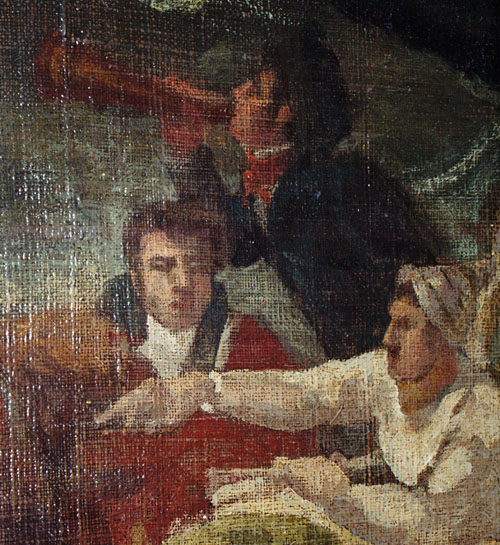
Shipwreck, the Rescue,
detail
Compare the trumpeter here with
the one in Turner’s Wreck of a Transport Ship
Thomas Griffith (1775-?) was
Turner’s agent (dealer) and the celebrated friend of many artists of his day. He was
listed on the Christie’s provenance as the first owner of Shipwreck, the
Rescue. The presentation of this painting to Thomas Griffith and the later
acquisitions by both Sir Charles Robinson and
James Orrock proves an
interesting link between Turner’s earliest paintings and the interest level
shown them by sophisticated collectors many years after they were first
painted. It confirms, that by heeding John Ruskin’s advice in the late 1840’s
to, ‘’’: refurbish’ some of his earlier haphazardly stored and vulnerable paintings
Turner was rewarded. It resulted in late support for his experimental and
historically important early works. One should certainly consider
Shipwreck, the Rescue a foremost example. It is known from biographical
information that the artist had innumerable choices for these late
restorations but he chose to revive this painting in particular, and as we
find out later, it was likely at the urging of Griffith himself. See the 1844
letter from Turner to Griffith about the ‘stormy picture’ [John Gage’s,
Collected Correspondence of J.M.W. Turner, (Clarendon Press
’ " Oxford, 1980)].
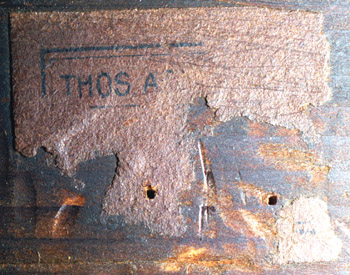 Enlarged image of the stamp-sized label found on the
stretcher of Shipwreck, the Rescue. The firm formerly known as Thos.
Agnew and Sons has indicated that it is not their fragmentary label, so one
might assume that it has something to do with Thos. Griffith (note the staple
holes)
In a letter of 1844, the likely year of the presentation of Shipwreck, the
Rescue to Griffith, “Turner consulted Griffith about his pictures for the
forthcoming exhibition… the letter shows how much Turner had by then come to
rely on Griffith’s advice.” (Evelyn Joll, Oxford Companion,
132)
Provenance is…
To highlight how the demand for greater provenance has evolved the
International Foundation for Art Research (IFAR) asked a number of
influential people in the art field what the word, ‘’’: provenance’ meant to them,
the answers ranged from the original meaning, “place of origin,” to the more
contemporary and complex concept put forth by the research consultant and
board member of the Appraisers Association of America, Hermine Chivian-Cobb:
“There are two definitions of provenance: the narrow one, which I
understand to mean the complete history of an object’s ownership, from the
time it left the artist’s hands (including names of dealers, private
collectors, and auction sales) and the broader definition which encompasses
the entire history of the work. This history would include, in addition to
collections, a complete description of the piece, with (for paintings and
drawings) medium, support, signature, title as given by the artist, or the
most commonly known, date measurements and other significant markings;
exhibition history, literature in which the work is discussed, mentioned or
illustrated, including catalogue raisonn (c) entries with the relevant number,
and condition, where applicable.
The provenance could also include any letters or certificates of
authenticity by an expert on the artist’s work and the prices for which an
object has changed hands.”
[xv]
Enlarged image of the stamp-sized label found on the
stretcher of Shipwreck, the Rescue. The firm formerly known as Thos.
Agnew and Sons has indicated that it is not their fragmentary label, so one
might assume that it has something to do with Thos. Griffith (note the staple
holes)
In a letter of 1844, the likely year of the presentation of Shipwreck, the
Rescue to Griffith, “Turner consulted Griffith about his pictures for the
forthcoming exhibition… the letter shows how much Turner had by then come to
rely on Griffith’s advice.” (Evelyn Joll, Oxford Companion,
132)
Provenance is…
To highlight how the demand for greater provenance has evolved the
International Foundation for Art Research (IFAR) asked a number of
influential people in the art field what the word, ‘’’: provenance’ meant to them,
the answers ranged from the original meaning, “place of origin,” to the more
contemporary and complex concept put forth by the research consultant and
board member of the Appraisers Association of America, Hermine Chivian-Cobb:
“There are two definitions of provenance: the narrow one, which I
understand to mean the complete history of an object’s ownership, from the
time it left the artist’s hands (including names of dealers, private
collectors, and auction sales) and the broader definition which encompasses
the entire history of the work. This history would include, in addition to
collections, a complete description of the piece, with (for paintings and
drawings) medium, support, signature, title as given by the artist, or the
most commonly known, date measurements and other significant markings;
exhibition history, literature in which the work is discussed, mentioned or
illustrated, including catalogue raisonn (c) entries with the relevant number,
and condition, where applicable.
The provenance could also include any letters or certificates of
authenticity by an expert on the artist’s work and the prices for which an
object has changed hands.”
[xv]

James Orrock’s London home showing two of his Turners, Walton Bridges (left)
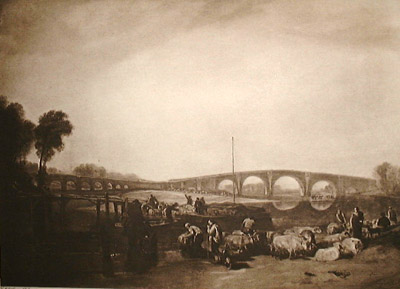
Walker E. Cockerell, after Walton Bridges by J.M.W. Turner RA
James Orrock RI: Painter, Connoisseur, Collector, vol. 1, pp. 28
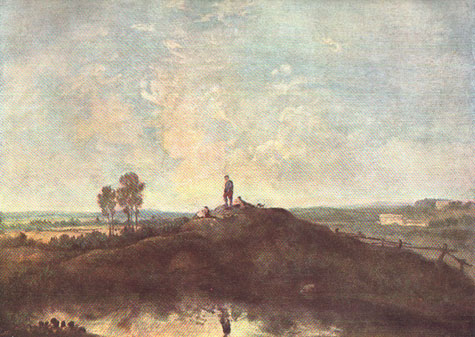 J.M.W. Turner, Heath Scene c1799, “oil colour” from the
James Orrock
collection. This was illustrated in the special Studio
publication of 1903 as the first reproduction of Turner’s work ever to be done
in colour; and although, it is missing from the BJ Catalogue, there is
mention made of this novel colour-publishing development written by Robert
Upstone in the
Oxford
Companion, p. 311.
The third
of Turner’s paintings to be published in full colour from the same noteworthy
Studio publication was Off the Nore’ “again owned by
Orrock and missing from
the 1977 BJ Catalogue. This second oversight was corrected by the time
of the second printing of the catalogue. This was at roughly the same time as
the painting entered the Paul Mellon collection.
J.M.W. Turner, Heath Scene c1799, “oil colour” from the
James Orrock
collection. This was illustrated in the special Studio
publication of 1903 as the first reproduction of Turner’s work ever to be done
in colour; and although, it is missing from the BJ Catalogue, there is
mention made of this novel colour-publishing development written by Robert
Upstone in the
Oxford
Companion, p. 311.
The third
of Turner’s paintings to be published in full colour from the same noteworthy
Studio publication was Off the Nore’ “again owned by
Orrock and missing from
the 1977 BJ Catalogue. This second oversight was corrected by the time
of the second printing of the catalogue. This was at roughly the same time as
the painting entered the Paul Mellon collection.
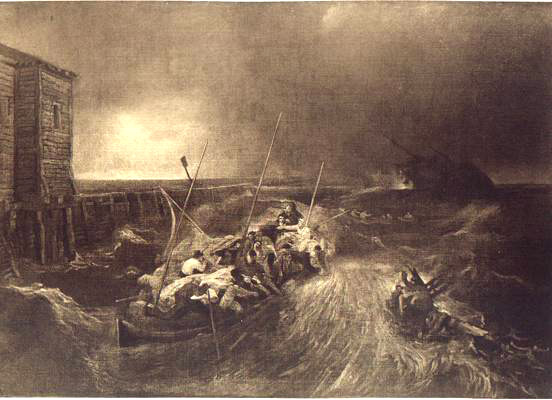 One of the major highlights of the research project came with the discovery
of this photogravure. Titled–The Wreck, it was found on page 74 of
vol. 1 of Orrock’s
biography. It was published the year before Shipwreck, the Rescue sold
at Christie’s
One of the major highlights of the research project came with the discovery
of this photogravure. Titled–The Wreck, it was found on page 74 of
vol. 1 of Orrock’s
biography. It was published the year before Shipwreck, the Rescue sold
at Christie’s
Art World’s Dirty Little Secret
r malcolm setters / graham setters
HOME
Terms and conditions J.M.W. Turner
Penticton
(c) setters 2003, Rescuing Turner: The Art Project & [/)