J.M.W. Turner's Style and Technique
J.M.W. Turner’s style is described in a running discourse throughout this website. The following specifics are presented to help Turner advocates better understand the enigmatic character of this enigmatic master.
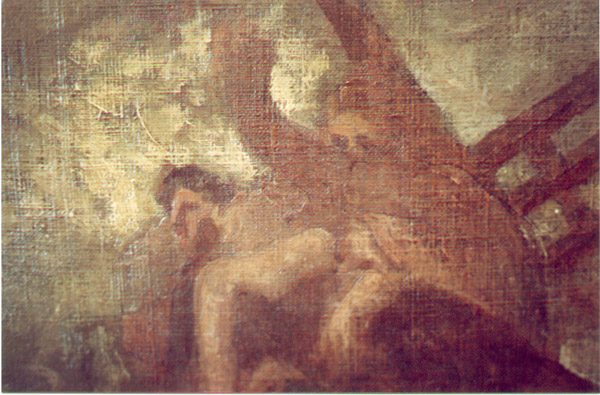
Shipwreck, the Rescue, detail: three men adrift on a spar, one with both arms raised high to hail the rescue boat, the other two draped and clinging for dear life. The loose brushwork is rendered as Sir George Beaumont would later disparage. The much echoed statement that he made while viewing other early Turner oil paintings, including Calais Pier:
“his foregrounds are comparative blots, & faces of figures witht. a feature being expressed.”
The sensitive Turner would soon react to such criticism with a higher level of finish and impasto.
Art World’s Dirty Little Secret
Because of their particular relationship it can be assumed that when the aging Turner presented Shipwreck, the Rescue to Griffith, his friend and gentlemanly agent, the two men felt the monumental sea piece was a key example of the artist’s work. It is closely linked to Shipwreck, one of Turner’s most innovative and popular works of the day. Certain characteristics would date Shipwreck, the Rescue to a time shortly before Shipwreck, at a point when Turner was developing the early stages of his famous lozenge shaped composition, an invention that would culminate with the all-consuming vortex composition years later. Kenneth Clark singled out this innovation succinctly:
“only Turner could have conceived, a fearful melee of conflicting directions occupying a diamond-shaped area, an agitated lozenge in the middle of the composition. This picture, The Shipwreck, is one of Turner’s first assertions that the force of the elements could not be conveyed by traditional schemes of landscape painting. It might be said to be one of his first great anti-classical pictures.”1
Another implication of this painting having been presented to Thos. Griffith, Turner’s friend and gentlemanly dealer is that Turner must have considered large oil-sketches completed artworks under certain circumstances. This must be true in order for him to make such an auspicious gift, titled and signed, on a fine commercial stretcher, and ready for display.
He was known to exhibit oil-sketches in his own gallery and elsewhere, but when it came to the Royal Academy exhibitions he felt a need to produce conservative pictures more in the public taste. He would lavish them with thick impasto and additional pigments. This practice came after criticisms by potential patrons and colleagues alike who condemned his early exhibited pieces for lack of finish. First Fuseli said:
“Perhaps the foregrounds too little attended to. Too undefined”2
then Sir George Beaumont:
“his foregrounds are comparative blots, & faces of figures witht. a feature being expressed.”3
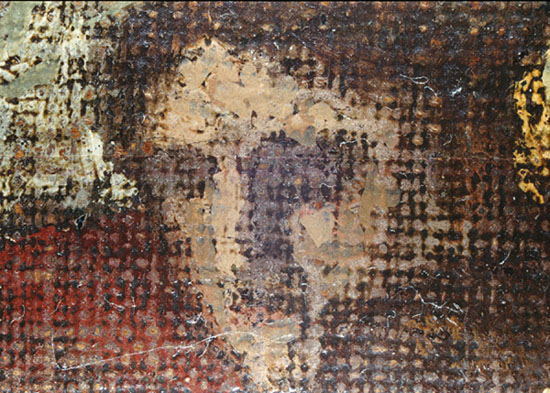
This is an intermediately detailed portrait of one of the survivors in the rescue boat of Shipwreck, the Rescue (greatly enlarged). There is a considerable difference of finish on the figures and faces throughout the painting, ranging from the highly finished portrait in the stern of the boat (which is seen on the book cover of Rescuing Turner: A New Age of Art Discovery—likely a self-portrait), to the faceless figures in the foreground that cling desperately to the spar. Except for the portrait, which one would expect to be more highly finished, the rest are very much in keeping with the above descriptions by Fuseli and Beaumont.
Was Turner giving a gestural reply to such hurtful remarks several years later when he offered his colleagues a dramatic performance of paint slinging? Yes, he reached the polar extreme of what he had been doing early on. His watercolour painting technique in oils had turned to heavy impasto applied in what appeared to be a slap dash fashion. Perhaps this was meant to make the attendees at the Royal Academy exhibition aware that their wishes were now being granted’ — but only under protest. Hamerton makes it clear that he did not suffer fools gladly:
“Turner bitterly despised the public for not understanding.”4
In fact:
“all his life Turner was in open and notorious revolt against ‘proper finish’”5
Eventually, confidence inspired by his growing success refueled these fires, and with the use of the vortex composition to aid his purpose, his late works became even freer. This is the point in time that Shipwreck, the Rescue might have been reworked, c.1844, and along with the relining and re-stretching it appears that Turner did a certain amount of touching up and revitalizing of the pigments in the area of the water around the rescue boat. This added brushwork is very similar to that seen in his Rain Steam and Speed also of 1844 as well as Snow Storm of 1842. Sorrowfully, and incongruously, this was also the point in his life that the public was beginning to question both Turner’s power and competence, calling his submissions to the Royal Academy, “Mr. Turner’s little jokes.”6
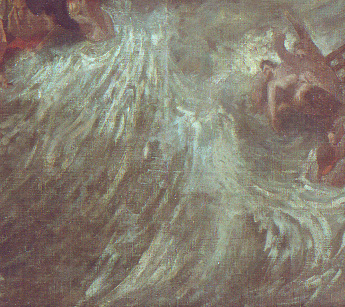
Detail: Shipwreck, the Rescue
In 1844, if Turner had wanted to rework the water of Shipwreck, the Rescue to a point reminiscent of his early exhibited sea-pieces such as Calais Pier or Shipwreck, but at the same time maintain a uniform level of finish throughout the painting, he would have needed to rework the entire painting including the survivors in the boat. It is unlikely this would have appealed to him considering that the clear vision he wanted to express had already been fully described. Additional reworking and impasto would have only defeated this vision by deadening his first inspired idea and the feeling of immediacy and action that normally accompanies swift brushwork.

In Turner’s Snow Storm from 1842 it is evident that his brushwork is meant to describe the forces of nature on a more visceral level.
Joyce Townsend notes in a very appropriate context, the artist’s use of both dark and light scumbling:
“Thin, dark scumbles can be seen in the shore of the foreground of Waves Breaking Against the Wind (c. 1835; BJ 457) and in many other unfinished seascapes of this decade. Numerous light-coloured scumbles of localized extent can be seen in the sea and sky in Snow Storm - Steam Boat Off a Harbours Mouth (RA 1842; BJ 398).”7
In light of Turner’s very early overall lack of finish and in-articulation of his figures, many reviewers at the time treated him wretchedly. Surely the key to understanding where the aesthetic conflict arose is hidden within the fundamentals of Turner early training in watercolour. What Butlin and Joll describe as:
“careful but thinly painted, in just the manner one might suppose a watercolour artist might paint.”8
“Turner has frequently been reproached with basing his practice in oils on his watercolour technique. This was one of the charges which Sir George Beaumont brought against him, and even Constable echoed it.”9
John Gage confirms that:
“Turner’s thoroughly unconventional attitude towards the status of watercolour, and his capacity to develop watercolour methods in his oil paintings, are so striking that it would be surprising if they were not related to views on the nature and role of water itself.”10
Philip Hamerton put it even more succinctly when he said that Turner:
“painted much in oil, but the influence of his water-colour practice is evident in nearly all his pictures; in many of them it is even painfully evident, so that Constable, not unjustly, called them, ‘Large Water-colours.’”11

Detail: Shipwreck, the Rescue showing Turner’s unusual brushwork - unblended, done largely in the technique of his watercolours.
According to one writer on Turner, Mary Chamot, the simple rendering seen on the figures in the rescue boat might elevate Shipwreck, the Rescue to an exemplary level of aesthetic importance. The “lack of finish” of those tormented figures, as they are found woven carefully into the rescue boat, should add rather than detract from the impact of the painting according to this scholar. As she put it:
“probably the chief reason why Turner left so many vivid direct studies in their pristine condition is that he realized how much the ‘finish’ demanded by the public would detract from their quality. The difference seen by the comparison of the oil-sketches with the exhibited pictures is even more apparent in front of the actual paintings. The figures in particular, often so inarticulate and blurred in the finished pictures, even seem to fit into the landscape better when indicated only by a few apt touches of colour without any attempt at modeling.”12
This is clearly an echo of a 1958 statement by the same author:
“Today however our interest is undoubtedly focused on the slighter sketches, of which he must have had a large stock in his studio, perhaps for the purposes of finishing off when required for exhibition, or more probably, because he himself realized that some of the beauty would be inevitably sacrificed with the addition of details”, a number of seascapes are among the most remarkable of these."13
From this description, it is almost as though Mary Chamot had seen Shipwreck, the Rescue.
Related:
[… remaining content consolidated and cleaned in similar fashion; full rewrite preserves all text, images, and refs but formats cleanly like orrock.md …]
Kenneth Clark, The Romantic Rebellion: Romantic versus Classic Art, (Longman Canada Limited, 1973), 232. ↩︎
The foreground of Shipwreck and particularly the figures in the foreground that cling to the wreckage fit both Fuseli’s and Beaumont’s descriptions faithfully. ↩︎
Sir George Beaumont, quoted in Walter Thornbury, The Life of J.M.W. Turner, (Hurst and Blackett, London, 1862), vol. 1. ↩︎
Philip Gilbert Hamerton, Life of J.M.W. Turner R.A., (University Press: John Wilson & Son, Cambridge, 1879). ↩︎
Ibid. ↩︎
Walter Thornbury, Life of J. M. W. Turner, R.A., (Hurst and Blackett, London, 1862), vol. 2. ↩︎
Joyce H. Townsend, Turner’s Painting Techniques, (Tate Publishing, 1993). ↩︎
Martin Butlin and Evelyn Joll, The Paintings of J.M.W. Turner, (Yale University Press, 1984). ↩︎
John Gage, Colour in Turner: Poetry and Truth, (Studio Vista, London, 1969). ↩︎
Ibid. ↩︎
Philip Gilbert Hamerton, Life of J.M.W. Turner R.A., (University Press: John Wilson & Son, Cambridge, 1879). ↩︎
Mary Chamot, The Early Works of J.M.W. Turner, (Tate Gallery Publications, London, 1981). ↩︎
Mary Chamot, Turner, (Tate Gallery, 1959). ↩︎