Edouard Manet
Manet expert Edouard Manet art expert opinion Wildenstein Institute, RRP, expert evaluation catalogue raisonne
In this day and
age the term art
expert is surely
sterile
 The
complexities of art appraisal, art evaluation, and art authentication are such
that most of those with an advanced understanding of the art world are loath to
get involved unless they have something to gain.
In the museum setting experts are most often unwilling to speak out in
support of a newly discovered or re-discovered painting because of orders from
senior institutional bureaucracy. Terms and expressions such as society,
institute, community of experts, research project are somewhat euphemistic.
Members of such self-supporting groups are in fact allies in a battle against
litigation first and foremost.
Most museum curators and institutional experts have little to gain and a lot
to lose if they wrongly accept a “dud” as authentic; and thus, in an attempt to
distance themselves from responsibility they more often become an obstruction to
those seeking a proper identification for their art work. Ultimately, it is
important to remember that a picture is often condemned for more complex
reasons than because it is spurious or fake. The following are areas that
must be fully considered when assessing authorship:
The
complexities of art appraisal, art evaluation, and art authentication are such
that most of those with an advanced understanding of the art world are loath to
get involved unless they have something to gain.
In the museum setting experts are most often unwilling to speak out in
support of a newly discovered or re-discovered painting because of orders from
senior institutional bureaucracy. Terms and expressions such as society,
institute, community of experts, research project are somewhat euphemistic.
Members of such self-supporting groups are in fact allies in a battle against
litigation first and foremost.
Most museum curators and institutional experts have little to gain and a lot
to lose if they wrongly accept a “dud” as authentic; and thus, in an attempt to
distance themselves from responsibility they more often become an obstruction to
those seeking a proper identification for their art work. Ultimately, it is
important to remember that a picture is often condemned for more complex
reasons than because it is spurious or fake. The following are areas that
must be fully considered when assessing authorship:
Source:
Art World’s Dirty Little Secret
r malcolm setters / graham setters
 forensics studies in art
art scientific analysis
connoisseurship
provenance
art politics
“‘In 1987, Sotheby’s paid out-of-court damages to the original owner of a Sebastiano del Piombo portrait knocked down for 180 at auction in Chester.
It subsequently sold for 330,000 in London, and - after being cleaned - for
a reported 6.5 million to the Getty (where quite a few rediscovered
masterpieces end up).’ (Ian Warrell/Warrell, The Age,
AU 2002)
“Even as early as 1931 Walter Bayes found that the
legal fears of one
influential official over authenticating paintings drove him to
incompetence. When Bayes asked: “Millionaires’ must tremble at your nod,”
the reply came: “If you knew my boy’ how much it is the other way round. The
interests concerned are so great, and money can do such strange things, that
I find it generally safer to hold my tongue.” (Walter Bayes, Turner, A
Speculative Portrait, p5)
forensics studies in art
art scientific analysis
connoisseurship
provenance
art politics
“‘In 1987, Sotheby’s paid out-of-court damages to the original owner of a Sebastiano del Piombo portrait knocked down for 180 at auction in Chester.
It subsequently sold for 330,000 in London, and - after being cleaned - for
a reported 6.5 million to the Getty (where quite a few rediscovered
masterpieces end up).’ (Ian Warrell/Warrell, The Age,
AU 2002)
“Even as early as 1931 Walter Bayes found that the
legal fears of one
influential official over authenticating paintings drove him to
incompetence. When Bayes asked: “Millionaires’ must tremble at your nod,”
the reply came: “If you knew my boy’ how much it is the other way round. The
interests concerned are so great, and money can do such strange things, that
I find it generally safer to hold my tongue.” (Walter Bayes, Turner, A
Speculative Portrait, p5)
 “In this regard, a personal experience came in 1988 with a visit to the
National Gallery, London. It was to do with a painting that came from the
estate of Rudolph Hermani (of the Krupp and Mercedes’ fame). Although the
gallery official that I was directed to, Alistair Smith, had confidently
given authorship of the little oil-on-panel to Lucas Cranach the Elder, I
was refused written conformation. The lack of success at the National
Gallery was the first time I experienced the art-world running scared. To
quote from his letter
written subsequent to my visit: “As
a member of staff of the National Gallery, I am not allowed to authenticate
paintings in private hands, and while I do not wish to be obstructive, I
would be very grateful if you would remove my name from any printed
materials which you are to issue.”
“In this regard, a personal experience came in 1988 with a visit to the
National Gallery, London. It was to do with a painting that came from the
estate of Rudolph Hermani (of the Krupp and Mercedes’ fame). Although the
gallery official that I was directed to, Alistair Smith, had confidently
given authorship of the little oil-on-panel to Lucas Cranach the Elder, I
was refused written conformation. The lack of success at the National
Gallery was the first time I experienced the art-world running scared. To
quote from his letter
written subsequent to my visit: “As
a member of staff of the National Gallery, I am not allowed to authenticate
paintings in private hands, and while I do not wish to be obstructive, I
would be very grateful if you would remove my name from any printed
materials which you are to issue.”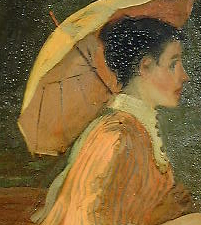 “Indubitably, this is a wide ranging problem: for many years John Walker
had encouraged the vetting of art at the National Gallery in Washington, but
as he wrote, “with strong opposition from our
legal advisors, who
feared we would be sued… I have always felt it wrong that so many American
museums, worried either by the possibilities of lawsuits or out of
ineptitude and laziness, refuse to help the public in what I consider an
essential way.”
“Indubitably, this is a wide ranging problem: for many years John Walker
had encouraged the vetting of art at the National Gallery in Washington, but
as he wrote, “with strong opposition from our
legal advisors, who
feared we would be sued… I have always felt it wrong that so many American
museums, worried either by the possibilities of lawsuits or out of
ineptitude and laziness, refuse to help the public in what I consider an
essential way.”
 Newly discovered
19thc painting signed Edouard Manet… vintage title-plate: Boating Near
Rueil
Excerpt from a recent letter to Guy Wildenstein:
“Among our other French
paintings the one that might bring the greatest admiration is Boating
Near Rueil c1874 by Edouard Manet, 30X40 inches. It is an un-catalogued
work and could very well have been one of those Manets brought to America
with the first wave of French Impressionist pictures early last century. It
was purchased from a very old North American collection which had sat in
storage for many years after the owner passed away. “It still has its vintage, and now,
much degraded ‘bitumen-darkened varnish;’ that infamous varnish that would have
been applied by ‘Durand-Ruel in order to temper the intense colors of
Impressionist canvases during the 1870s,’(Ren (c) Gimple
quoting Monet)
Although difficult to
detect beneath the degraded antique varnish, it is signed
on the stern of the boat (as seen here in the detail) in the manner Manet was using at the time.
Newly discovered
19thc painting signed Edouard Manet… vintage title-plate: Boating Near
Rueil
Excerpt from a recent letter to Guy Wildenstein:
“Among our other French
paintings the one that might bring the greatest admiration is Boating
Near Rueil c1874 by Edouard Manet, 30X40 inches. It is an un-catalogued
work and could very well have been one of those Manets brought to America
with the first wave of French Impressionist pictures early last century. It
was purchased from a very old North American collection which had sat in
storage for many years after the owner passed away. “It still has its vintage, and now,
much degraded ‘bitumen-darkened varnish;’ that infamous varnish that would have
been applied by ‘Durand-Ruel in order to temper the intense colors of
Impressionist canvases during the 1870s,’(Ren (c) Gimple
quoting Monet)
Although difficult to
detect beneath the degraded antique varnish, it is signed
on the stern of the boat (as seen here in the detail) in the manner Manet was using at the time.
 The
central feature of the painting, a young lady sitting in a boat holding a
parasol is the same unidentified girl seen in Boating. Her hat rests on
the side of the boat and is the same one that she
The
central feature of the painting, a young lady sitting in a boat holding a
parasol is the same unidentified girl seen in Boating. Her hat rests on
the side of the boat and is the same one that she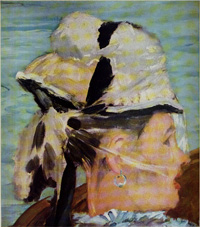 wears in Boating. In
keeping with Manet’s working method the painting has a considerable amount of
pentimenti.
Figure comparison from Boating
“‘I’ll tell you,’ Monet replied, ’that when we were
starting out, Durand-Ruel said to us: “The collectors find your canvases too
chalky. To sell them I’m obliged to varnish them with bitumen.’ You’ll
understand M. Gimpel, that we weren’t exactly delighted with that, but one had
to live!” (Ren (c) Gimpel, Diary of an Art Dealer, Feb. 1920,
p. 130)
wears in Boating. In
keeping with Manet’s working method the painting has a considerable amount of
pentimenti.
Figure comparison from Boating
“‘I’ll tell you,’ Monet replied, ’that when we were
starting out, Durand-Ruel said to us: “The collectors find your canvases too
chalky. To sell them I’m obliged to varnish them with bitumen.’ You’ll
understand M. Gimpel, that we weren’t exactly delighted with that, but one had
to live!” (Ren (c) Gimpel, Diary of an Art Dealer, Feb. 1920,
p. 130)
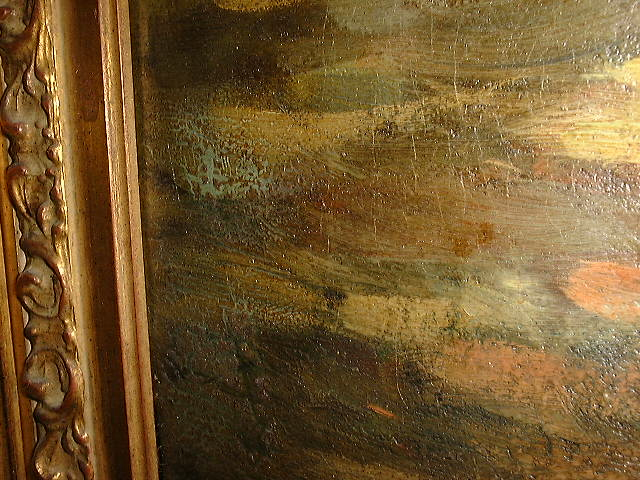 small congealed area (center left of this
detail) shows the brightness
of the paint to be found under the degraded bituminous varnish
Manet on the Seine
During the summer of 1874 Manet painted scenes of the Seine at Argenteuil
alongside Renoir and Monet, the, ‘’’: arch-exponents of Impressionism’. This period
marked, “one of the most important periods in impressionism, Monet, Manet, and
Renoir painted side by side and succeeded in further developing their personal
styles.”[i]
This also led to an intermixing of ideas resulting in much influence on each
other’s work. Monet’s influence on Manet is apparent in Boating Near Rueil
(seen above) and several other, ‘’’: seinescapes’: “Manet’s association with Monet
led to a change in his work, but it was very much a cross-fertilization with
each artist learning from each other at different times.”[ii]
This, ‘’’: cross-fertilization’ caused Manet to embrace certain impressionist ideals
while retaining elements of his earlier style. Works such as Boating
(portrait detail above), Boating Near Rueil, and The Seine Banks at
Argentueil (seen here
small congealed area (center left of this
detail) shows the brightness
of the paint to be found under the degraded bituminous varnish
Manet on the Seine
During the summer of 1874 Manet painted scenes of the Seine at Argenteuil
alongside Renoir and Monet, the, ‘’’: arch-exponents of Impressionism’. This period
marked, “one of the most important periods in impressionism, Monet, Manet, and
Renoir painted side by side and succeeded in further developing their personal
styles.”[i]
This also led to an intermixing of ideas resulting in much influence on each
other’s work. Monet’s influence on Manet is apparent in Boating Near Rueil
(seen above) and several other, ‘’’: seinescapes’: “Manet’s association with Monet
led to a change in his work, but it was very much a cross-fertilization with
each artist learning from each other at different times.”[ii]
This, ‘’’: cross-fertilization’ caused Manet to embrace certain impressionist ideals
while retaining elements of his earlier style. Works such as Boating
(portrait detail above), Boating Near Rueil, and The Seine Banks at
Argentueil (seen here )
all exemplify a shift in Manet’s style while demonstrating his unwillingness to
completely conform to the impressionist movement.
The practice of painting en plein air (in open air) is an important
characteristic of the impressionist movement. In 1869, “Monet and Renoir, whose
figures and compositions done in the open air had been inspired by Gustave
Courbet, painted together at Bougival, a small village on the Seine.”[iii]
In an effort to capture, ‘’’: the dynamism and joy’ of a picturesque wharf which was
always surrounded by a, “restless confusion of boats and women in gaily colored
dresses,”[iv]
each artist painted their version of La Grenouill re en plein air. After
the Franco-Prussian war, Monet settled in Argenteuil and in 1872, “began
painting the new type of open-air landscapes.”[v]
These paintings, which, “were dominated by the phantasms of light, attracted
Renoir, Sisley and Manet.”[vi]
This attraction led Manet to spend the pivotal summer of 1874 in Argenteuil;
however, certain evidence suggests that Manet never fully accepted the practice
of, ‘’’: plein air’ painting. For example, it is thought that Boating was
painted in the studio because of its large size (38 " x 51 “). It was “much
larger than the portable canvases Monet and Renoir were using at this time and
would suggest it was done in the studio.”[vii]
The “rather contrived nature of the composition”[viii]
would also support this theory. Argenteuil is another example of a work
during this period that was doubtfully painted en plein air. Firstly,
the size of the canvas (60” x 45”) was “much larger than the typical
impressionist canvases, which had to be easily portable to facilitate plein air
practice.”[ix]
Also, “the apparent spontaneity of the work belies its rigorously premeditated
system of horizontals and verticals”[x]
As Manet started to abandon the, ‘’’: contrived nature’ of his compositions for a
freer, “more spontaneous approach”[xi]
his canvases started to decrease in size. Boating Near Rueil is smaller
(30” x 40”) which rendered it more portable; and thus, it was conceivably
completely or partially executed from life. The loose and spontaneous brushwork
apparent in the background suggests that Manet was trying to capture a fleeting
impression, possibly before the loss of daylight. The model, however, appears
to be carefully painted and both it and the area near the hat exhibit extensive
petimenti. Unlike Monet, Manet was known for his changes, those made to achieve
a more balanced and harmonious composition. In The Seine Banks at Argenteuil
the size of the canvas decreases once again (24” x 39 “). This smaller
more portable canvas is almost exactly the same size as Monet’s The Regatta
at Argenteuil. The subject matter of Manet’s painting is described by Linda
Bolton as: “pure Impressionist”[xii]
and, “the broken brushwork, which conveys a sense of movement, is also in the
Impressionist idiom’ “[xiii]
Boating Near Rueil undeniably has Impressionist elements, however
it is clearly only a stage in Manet’s evolution, one which culminated in works
such as The Seine Banks at Argenteuil and Claude Monet painting in his
Studio Boat.
Manet described Monet as, “The Raphael of water.” His high regard for
this idea was revealed when attempting to emulate Monet’s ability to depict
water. This admiration led Manet to, “attempt to catch the fleeting effects of
light and water that so entranced Monet.”[xiv]
Manet also felt that Monet had an understanding of water’s mystery and “all of
its moods.” Consequently, Manet took Monet’s lead in this regard and tried to
emulate similar reflections in water.[xv]
In works such as The Seine Banks at Argenteuil and Boating Near Rueil
Monet’s influence is easily observed as Manet uses broken, directional, and bold
brushwork to capture the reflections and the effects of light. Although at this
time Manet employed a more directional brushstroke than in his earlier work, he
never came close to the formality that Monet applied it in works such as The
Regatta at Argenteuil. Manet, however, did not limit himself to this type
of brushwork; in Boating the water has a much more flat, non-directional
application of paint. It was apparent that Manet admired and tried to emulate
Monet’s ability to delineate reflections in water; however, unlike Monet, “he
did not record the reflections in the water with any close attention to their
actual appearance.”[xvi]
In Boating Near Rueil the reflections of the model’s dress and the stern
of the boat are vaguely suggested with a tonal change and oblique brushstrokes,
“whereas Monet’s reflections were always closely observed, spreading down
directly below the objects reflected.”[xvii]
The transition of Manet’s style during his summer at Argenteuil can be easily
observed in his three paintings: Boating, Boating Near Rueil and The
Seine Banks at Argenteuil. As aforementioned, Manet’s execution of water
frequently mirrored the influence of Monet; however, other changes are also
apparent in other areas of the works. For example, in these three paintings
Manet’s shift from an emphasis on figural to landscape is very distinct. As a
general rule, “figures were always more important to him than landscapes.”[xviii] Manet
made an observable shift in emphasis from the figure; as seen in Boating,
to landscape; as seen in The Seine Banks at Argenteuil, with Boating
Near Rueil falling somewhere in between. The figure in the painting is
still given a prominent location that demands attention; however, it does not
monopolize the picture as is the case with Boating. The Seine Banks at
Argenteuil marks the final stage in Manet’s transition, “the figures,
usually of paramount importance in Manet’s paintings, are here merely an
incidental part of the landscape.”[xix] This
gradual transformation has been interpreted as Manet, “submitting himself both
to the landscape and to the technique of his younger colleagues.”[xx]
Manet’s tendency to allocate more importance to certain elements in his
paintings, namely his figures, “contradicts the Impressionists’ almost
egalitarian approach to the landscape ’ " where one element is rendered with as
much or as little importance to the next.”[xxi]
Further contradicting this approach Manet endeavored to emphasize his model’s
individuality. Manet accomplishes this with the use of, “clothes, particularly
hats, to provide emphasis and bring out the individuality of a face.”[xxii]
Manet’s use of clothing in his works also brings out the individuality of his
models due to social attitudes of the day. The following extract from a
contemporary magazine illustrates the contemporary lady’s mentality towards
their fashion:
)
all exemplify a shift in Manet’s style while demonstrating his unwillingness to
completely conform to the impressionist movement.
The practice of painting en plein air (in open air) is an important
characteristic of the impressionist movement. In 1869, “Monet and Renoir, whose
figures and compositions done in the open air had been inspired by Gustave
Courbet, painted together at Bougival, a small village on the Seine.”[iii]
In an effort to capture, ‘’’: the dynamism and joy’ of a picturesque wharf which was
always surrounded by a, “restless confusion of boats and women in gaily colored
dresses,”[iv]
each artist painted their version of La Grenouill re en plein air. After
the Franco-Prussian war, Monet settled in Argenteuil and in 1872, “began
painting the new type of open-air landscapes.”[v]
These paintings, which, “were dominated by the phantasms of light, attracted
Renoir, Sisley and Manet.”[vi]
This attraction led Manet to spend the pivotal summer of 1874 in Argenteuil;
however, certain evidence suggests that Manet never fully accepted the practice
of, ‘’’: plein air’ painting. For example, it is thought that Boating was
painted in the studio because of its large size (38 " x 51 “). It was “much
larger than the portable canvases Monet and Renoir were using at this time and
would suggest it was done in the studio.”[vii]
The “rather contrived nature of the composition”[viii]
would also support this theory. Argenteuil is another example of a work
during this period that was doubtfully painted en plein air. Firstly,
the size of the canvas (60” x 45”) was “much larger than the typical
impressionist canvases, which had to be easily portable to facilitate plein air
practice.”[ix]
Also, “the apparent spontaneity of the work belies its rigorously premeditated
system of horizontals and verticals”[x]
As Manet started to abandon the, ‘’’: contrived nature’ of his compositions for a
freer, “more spontaneous approach”[xi]
his canvases started to decrease in size. Boating Near Rueil is smaller
(30” x 40”) which rendered it more portable; and thus, it was conceivably
completely or partially executed from life. The loose and spontaneous brushwork
apparent in the background suggests that Manet was trying to capture a fleeting
impression, possibly before the loss of daylight. The model, however, appears
to be carefully painted and both it and the area near the hat exhibit extensive
petimenti. Unlike Monet, Manet was known for his changes, those made to achieve
a more balanced and harmonious composition. In The Seine Banks at Argenteuil
the size of the canvas decreases once again (24” x 39 “). This smaller
more portable canvas is almost exactly the same size as Monet’s The Regatta
at Argenteuil. The subject matter of Manet’s painting is described by Linda
Bolton as: “pure Impressionist”[xii]
and, “the broken brushwork, which conveys a sense of movement, is also in the
Impressionist idiom’ “[xiii]
Boating Near Rueil undeniably has Impressionist elements, however
it is clearly only a stage in Manet’s evolution, one which culminated in works
such as The Seine Banks at Argenteuil and Claude Monet painting in his
Studio Boat.
Manet described Monet as, “The Raphael of water.” His high regard for
this idea was revealed when attempting to emulate Monet’s ability to depict
water. This admiration led Manet to, “attempt to catch the fleeting effects of
light and water that so entranced Monet.”[xiv]
Manet also felt that Monet had an understanding of water’s mystery and “all of
its moods.” Consequently, Manet took Monet’s lead in this regard and tried to
emulate similar reflections in water.[xv]
In works such as The Seine Banks at Argenteuil and Boating Near Rueil
Monet’s influence is easily observed as Manet uses broken, directional, and bold
brushwork to capture the reflections and the effects of light. Although at this
time Manet employed a more directional brushstroke than in his earlier work, he
never came close to the formality that Monet applied it in works such as The
Regatta at Argenteuil. Manet, however, did not limit himself to this type
of brushwork; in Boating the water has a much more flat, non-directional
application of paint. It was apparent that Manet admired and tried to emulate
Monet’s ability to delineate reflections in water; however, unlike Monet, “he
did not record the reflections in the water with any close attention to their
actual appearance.”[xvi]
In Boating Near Rueil the reflections of the model’s dress and the stern
of the boat are vaguely suggested with a tonal change and oblique brushstrokes,
“whereas Monet’s reflections were always closely observed, spreading down
directly below the objects reflected.”[xvii]
The transition of Manet’s style during his summer at Argenteuil can be easily
observed in his three paintings: Boating, Boating Near Rueil and The
Seine Banks at Argenteuil. As aforementioned, Manet’s execution of water
frequently mirrored the influence of Monet; however, other changes are also
apparent in other areas of the works. For example, in these three paintings
Manet’s shift from an emphasis on figural to landscape is very distinct. As a
general rule, “figures were always more important to him than landscapes.”[xviii] Manet
made an observable shift in emphasis from the figure; as seen in Boating,
to landscape; as seen in The Seine Banks at Argenteuil, with Boating
Near Rueil falling somewhere in between. The figure in the painting is
still given a prominent location that demands attention; however, it does not
monopolize the picture as is the case with Boating. The Seine Banks at
Argenteuil marks the final stage in Manet’s transition, “the figures,
usually of paramount importance in Manet’s paintings, are here merely an
incidental part of the landscape.”[xix] This
gradual transformation has been interpreted as Manet, “submitting himself both
to the landscape and to the technique of his younger colleagues.”[xx]
Manet’s tendency to allocate more importance to certain elements in his
paintings, namely his figures, “contradicts the Impressionists’ almost
egalitarian approach to the landscape ’ " where one element is rendered with as
much or as little importance to the next.”[xxi]
Further contradicting this approach Manet endeavored to emphasize his model’s
individuality. Manet accomplishes this with the use of, “clothes, particularly
hats, to provide emphasis and bring out the individuality of a face.”[xxii]
Manet’s use of clothing in his works also brings out the individuality of his
models due to social attitudes of the day. The following extract from a
contemporary magazine illustrates the contemporary lady’s mentality towards
their fashion:
In 1869 the Englishwoman’s Domestic Magazine reported on a visit to a couturiere en vogue that stated:, ‘’’: Each lady comes to ask me not what is worn but what has not yet even been seen or worn’ ‘[xxiii]
Because ladies were desirous to be clothed in an original and distinctive way, it would make it very improbable for them to allow their clothes (i.e. hats) to be worn by other ladies. For this reason, when examining works painted by Manet, it is possible to identify the models simply by using their clothing as a type of character trait. For example, Suzanne Manet can be identified in On the Beach, and The Swallows because she is wearing the same hat in both works. Madame Monet can also be identified in The Seine Banks at Argenteuil and The Monet Family in the Garden because she also wears her hat in both works. Following this rationale it can be deduced that the same model is posing for both Boating Near Rueil and Boating, as the hats are identical and only appear in these two works. This emphasis on the individuality of his models shows Manet’s tendency, “to select from the scene and emphasize certain elements.”[xxiv] This undeniably opposes the, ‘’’: egalitarian approach’ of the Impressionist idiom; however, it exemplifies his interest in figures that would dominate his future works such as Un Bar aux Folies- Berg re. An arch-characteristic of the impressionist movement was their use of colour in regards to colour theory of the day: The impressionists were particularly concerned with the truthfulness of colour, understanding that no colour stands unaffected by the colour of its neighbor, techniques were developed of optical colour blending in which the viewers eye would combine adjoining patches of seemingly inappropriate colour into a new and suitable (perceived) colour.[xxv]
Although, “Manet was tremendously influenced by the lighter palette’ of his two colleagues”[xxvi] he never completely adopted their theories. The Seine Banks at Argenteuil, said to be the culmination of Manet’s impressionist evolution, is a great example of Manet’s appreciation of his younger colleagues’ theories without adopting them in their entirety. In this work Manet’s use of, “color, although light and bright, is not used in the Impressionist prismatic manner, nor does Manet seem concerned with a precise color notation.”[xxvii] A very distinctive difference exists between Manet’s use of colour in regards to Monet and Renoir: “’ although he lightened and brightened his palette in response to his friends’ theories, he did not restrict himself to primary colors, continuing to use black and some earth colours.”[xxviii]. In his work The Seine Banks at Argenteuil Manet’s decision to paint the hulls of the boats black, " [a] pigment outlawed by the orthodox impressionists,”[xxix] showed his reluctance to abandon the teachings of his master, Couture. Manet has been long considered the father of the impressionist movement. This has, however, caused misconceptions about his attitude and involvement in the movement. Although Manet admired Monet and Renoir’s artistic ability he never completely adopted their style and theories in his own work. During the summer of 1874 Manet’s admiration for the impressionists, namely Monet, caused him to selectively apply what he liked to his own style. As a result his style took a decisive shift in which many similarities can be found between his work and that of Monet. However, Manet also chose to retain elements from his previous style refusing to completely conform to the impressionist movement. In Manet’s most impressionist seinescape, The Seine Banks of Argenteuil, components such as his treatment of the water, the loose spontaneous brushwork, light palette, and close attention to landscape all denote an Impressionist inspired work. However, in works such as Boating Near Rueil and Boating Manet’s unwavering affinity for his models contradict the Impressionist egalitarian approach where no one element is more important than the next. Manet also refused to adopt the Impressionist’s colour theory and continued to use the, ‘’’: outlawed’ black pigment. Upon examining several of Manet’s works done during his summer in Argenteuil it becomes very obvious that Monet and the Impressionist’s had an impact on Manet’s work; however, Manet never came to embrace certain key elements that characterized the impressionist movement. (Graham Setters 1998, from 2nd term paper, Herstmonceux, Queen’s University)
Works Cited
Abrams, Harry. Manet. New York: Metropolitan Museum of Art, 1983. Adler, Kathleen. Manet. Oxford: Phaidon Press, 1986. Bolton, Linda. The History and Techniques of the Great Masters: Manet. London: Quarto Publishing plc, 1989. Brombert, Beth. Edouard Manet: Rebel in a Frock Coat. London: Little, Brown and Company, 1996. Cachin, Fran oise. Manet. New York: Henry Holt and Company, 1990. Copplestone, Trewin. The History and Techniques of the Great Masters: Monet. London: Quarto Publishing plc, 1987. Courtald Institute comp. The Courtald Collection. Washington: Yale University Press, 1987. Eickel, Nancy. Impressionists on the Seine. Washington: Publishers Group West, 1997. Encyclopedia Britannica comp. Encyclopedia of Art. London: Encyclopedia Britannica International Ltd, 1971. Hamilton, George. Manet and his Critics. New York: W.W. Norton and Company, 1969. Hanson, Anne. Manet and the Modern Tradition. London: Yale University Press, 1977. Hunt, Phil, ed. Manet. London: Porling Kindersley, 1993. Richardson, John. Edouard Manet. London: Phaidon Press, 1958. Rothstein, Natalie, ed. Four Hundred Years of Fashion. London: William Collins Sons & Co Ltd, 1984. Stevenson, Lesley. Manet. London: Bison Books, 1992.
[i] Rothkopf p77 [ii] Bolton p40 [iii] Encyclopedia of Art p953 [iv] Encyclopedia of Art p953 [v] Encyclopedia of Art p953 [vi] Encyclopedia of Art p953 [vii] Stevenson p125 [viii] Stevenson p125 [ix] Stevenson p126 [x] Stevenson p126 [xi] Bolton p40 [xii] Bolton p40 [xiii] Bolton p40 [xiv] Bolton p40 [xv] Bolton p40 [xvi] Courtauld p38 [xvii] Courtauld p38 [xviii] Cachin p22 [xix] Bolton p41 [xx] Brettell p118 [xxi] Hunt p55 [xxii] Cachin p24 [xxiii] V & A p54 [xxiv] Hunt p55 [xxv]http://frenchculture.miningco.com/library/weekly/aa041398.htm?pid=2745&cob=home [xxvi] Eickel p77 [xxvii] Bolton p40 [xxviii] Bolton p41 [xxix] Stevenson p22 JMWT bequest news corresp discovery style provenance connoisseur Orrock forensic signature Butlin legal catalogue portrait sting Courbet Roach old St Durer medal Unknown Turner ngc shipwreck IFAR/RRP institutional copies book your story Hand C theory C dialogue expertise expert Kayser “Copy” Murillo Lost Boucher Durer or Cranach Monet
Penticton
(c) setters 2003, Rescuing Turner: The Art Project & [/)