Legal Fears: Martin Butlin, Tate, and Christie's
| JMW Turner the source JMW Turner expert, expert opinion Evelyn Joll for Huntington/Huntington Museum, San Marino/Sotheby’s out-of-court damages/The Getty/Getty Museum, “where quite a few rediscovered masterpieces end up”

 Martin Butlin and Graham
Setters in Penticton
Excerpt:
Rescuing Turner: A New Age of Art Discovery:
r malcolm setters / graham setters
“My
opinion is entirely non-technical, although there
is some technical. My opinion is based on something much more intangible
than a fingerprint or relining [of the painting] or whatever. The weight of
my opinion, and in a way, to me, it’s very heavy…” Martin lost
focus for a moment then continued, “but on the other hand, in a court of
law, it might not have any weight at all…” Did something from the past
come back to haunt him? As I tried to get Martin to give an alternate name
for the creator of
Shipwreck, the Rescue by stating, “You’re the expert on British
paintings.” Martin concurred, “fair enough, fair enough ’ " but’ " His
meditation persisted as if he were remembering a terrible ordeal. Perhaps
the one his late friend Evelyn Joll had endured while testifying for the
Huntington Museum in San Marino, CA?
With an uneven voice Martin
uncomfortably compared this story to his own situation, “Put me up in front
of a really good defense advocate’ " He appeared to shudder at the thought
and continued, “I mean Evelyn Joll was grilled about a valuation that
Agnew’s put on a Reynolds full-length portrait that was burned in a fire’ He
said that he was never prepared to go through that experience again ’ "
because he got such a grilling, and I’m not particularly’ “wouldn’t want ’ "
The fearful Martin then howled: “These people are terror!”
Was this eruption an important clue to why Martin had rejected so many
Turner discoveries over his many years in office? Was Martin frightened to
support a picture’s authenticity for fear of being reproached at a future
date’ “and was he possibly worried about being forced into the courtroom to
defend his decision…
In 1987, Sotheby’s paid out-of-court damages to the original owner of a
Sebastiano del Piombo portrait knocked down for 180 at auction in Chester.
It subsequently sold for 330,000 in London, and - after being cleaned - for
a reported 6.5 million to the Getty (where quite a few rediscovered
masterpieces end up). (Ian Warrell/Warrell, The Age,
AU 2002)
Even as early as 1931 Walter Bayes found that the
legal fears of one
influential official over authenticating paintings drove him to
incompetence. When Bayes asked: “Millionaires’ must tremble at your nod,”
the reply came: “If you knew my boy’ how much it is the other way round. The
interests concerned are so great, and money can do such strange things, that
I find it generally safer to hold my tongue.” (Walter Bayes, Turner, A
Speculative Portrait, p5)
In this regard, a personal experience came in 1988 with a visit to the
National Gallery, London. It was to do with a painting that came from the
estate of Rudolph Hermani (of the Krupp and Mercedes’ fame). Although the
gallery official that I was directed to, Alistair Smith, had confidently
given authorship of the little oil-on-panel to Lucas Cranach the Elder, I
was refused written conformation. The lack of success at the National
Gallery was the first time I experienced the art-world running scared. To
quote from his letter
written subsequent to my visit: “As
a member of staff of the National Gallery, I am not allowed to authenticate
paintings in private hands, and while I do not wish to be obstructive, I
would be very grateful if you would remove my name from any printed
materials which you are to issue.”
Indubitably, this is a wide ranging problem: for many years John Walker
had encouraged the vetting of art at the National Gallery in Washington, but
as he wrote, “with strong opposition from our
legal advisors, who
feared we would be sued… I have always felt it wrong that so many American
museums, worried either by the possibilities of lawsuits or out of
ineptitude and laziness, refuse to help the public in what I consider an
essential way.”
Alas, could Martin have
been aping the great Turner himself? Thornbury tells us that
“Turner would never verify a picture. He told a friend that he had done so
once, and the result was that he was put in the witness-box at a trial., ‘’’: It
was the first,’ he said,, ‘’’: and it shall be the last.’”[i]
One can only assume that even back then ’those people were terror’.
Martin Butlin and Graham
Setters in Penticton
Excerpt:
Rescuing Turner: A New Age of Art Discovery:
r malcolm setters / graham setters
“My
opinion is entirely non-technical, although there
is some technical. My opinion is based on something much more intangible
than a fingerprint or relining [of the painting] or whatever. The weight of
my opinion, and in a way, to me, it’s very heavy…” Martin lost
focus for a moment then continued, “but on the other hand, in a court of
law, it might not have any weight at all…” Did something from the past
come back to haunt him? As I tried to get Martin to give an alternate name
for the creator of
Shipwreck, the Rescue by stating, “You’re the expert on British
paintings.” Martin concurred, “fair enough, fair enough ’ " but’ " His
meditation persisted as if he were remembering a terrible ordeal. Perhaps
the one his late friend Evelyn Joll had endured while testifying for the
Huntington Museum in San Marino, CA?
With an uneven voice Martin
uncomfortably compared this story to his own situation, “Put me up in front
of a really good defense advocate’ " He appeared to shudder at the thought
and continued, “I mean Evelyn Joll was grilled about a valuation that
Agnew’s put on a Reynolds full-length portrait that was burned in a fire’ He
said that he was never prepared to go through that experience again ’ "
because he got such a grilling, and I’m not particularly’ “wouldn’t want ’ "
The fearful Martin then howled: “These people are terror!”
Was this eruption an important clue to why Martin had rejected so many
Turner discoveries over his many years in office? Was Martin frightened to
support a picture’s authenticity for fear of being reproached at a future
date’ “and was he possibly worried about being forced into the courtroom to
defend his decision…
In 1987, Sotheby’s paid out-of-court damages to the original owner of a
Sebastiano del Piombo portrait knocked down for 180 at auction in Chester.
It subsequently sold for 330,000 in London, and - after being cleaned - for
a reported 6.5 million to the Getty (where quite a few rediscovered
masterpieces end up). (Ian Warrell/Warrell, The Age,
AU 2002)
Even as early as 1931 Walter Bayes found that the
legal fears of one
influential official over authenticating paintings drove him to
incompetence. When Bayes asked: “Millionaires’ must tremble at your nod,”
the reply came: “If you knew my boy’ how much it is the other way round. The
interests concerned are so great, and money can do such strange things, that
I find it generally safer to hold my tongue.” (Walter Bayes, Turner, A
Speculative Portrait, p5)
In this regard, a personal experience came in 1988 with a visit to the
National Gallery, London. It was to do with a painting that came from the
estate of Rudolph Hermani (of the Krupp and Mercedes’ fame). Although the
gallery official that I was directed to, Alistair Smith, had confidently
given authorship of the little oil-on-panel to Lucas Cranach the Elder, I
was refused written conformation. The lack of success at the National
Gallery was the first time I experienced the art-world running scared. To
quote from his letter
written subsequent to my visit: “As
a member of staff of the National Gallery, I am not allowed to authenticate
paintings in private hands, and while I do not wish to be obstructive, I
would be very grateful if you would remove my name from any printed
materials which you are to issue.”
Indubitably, this is a wide ranging problem: for many years John Walker
had encouraged the vetting of art at the National Gallery in Washington, but
as he wrote, “with strong opposition from our
legal advisors, who
feared we would be sued… I have always felt it wrong that so many American
museums, worried either by the possibilities of lawsuits or out of
ineptitude and laziness, refuse to help the public in what I consider an
essential way.”
Alas, could Martin have
been aping the great Turner himself? Thornbury tells us that
“Turner would never verify a picture. He told a friend that he had done so
once, and the result was that he was put in the witness-box at a trial., ‘’’: It
was the first,’ he said,, ‘’’: and it shall be the last.’”[i]
One can only assume that even back then ’those people were terror’.
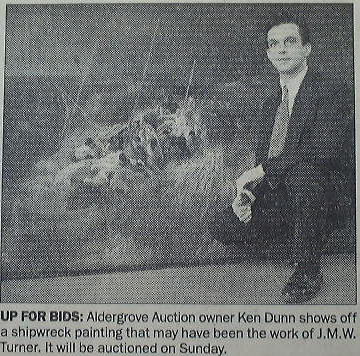 Vancouver Sun Jan 23 1997
“A surprise
came two days after the 1997 auction of
Shipwreck, the Rescue when a criminal lawyer who had first hand
knowledge of the painting phoned to give friendly advice. This was Mr.
Dowding; he had been following the painting controversy in the press, and
after noting the results of the auction, decided to phone and share his own
tale of intrigue as it related to the painting. The owner of Shipwreck,
the Rescue, back in 1982 fled the country with Interpol and the Mounties
(RCMP) close on his heels. The risk of going to jail caused him to abandon
his home, painting, and all he had accumulated since coming to Canada from
Europe. After many years in the art business the venerable James Henry
Duveen wrote that, “Dark dealings surround practically ever great art
treasure in the world.”[i]
Was this the first hint that we were dealing with a great art treasure? The
voice on the phone was slow and succinct. He had been the defense lawyer for
the man on the lam, the fellow who left the Mounties, ‘’’: without their man’ and
my confidant without his fee; Mr. Franz Visnei was now in the Caribbean or
some such place according to his former disgruntled lawyer.
For Mr. Dowding
it was not a great way to leave a profession of many years: 1982 was the
last year he practiced before retiring. It was curious that he still seemed
so concerned about the painting after twenty years’ “clearly this unresolved
case left him uneasy. He shared with me his certainty that he and his client
would have been victorious in court, at least with regard to the painting.
When Mr. Visnei jumped bail, Mr. Dowding was left high and dry with nothing
to defend. Because of other reasons spawned during the undercover
investigation, his client was expected to spend time behind bars anyway.
After he hesitantly promised to try and ferret out the
transcripts from the
trial, he hung up. I did not hear from him again for almost two years…
Vancouver Sun Jan 23 1997
“A surprise
came two days after the 1997 auction of
Shipwreck, the Rescue when a criminal lawyer who had first hand
knowledge of the painting phoned to give friendly advice. This was Mr.
Dowding; he had been following the painting controversy in the press, and
after noting the results of the auction, decided to phone and share his own
tale of intrigue as it related to the painting. The owner of Shipwreck,
the Rescue, back in 1982 fled the country with Interpol and the Mounties
(RCMP) close on his heels. The risk of going to jail caused him to abandon
his home, painting, and all he had accumulated since coming to Canada from
Europe. After many years in the art business the venerable James Henry
Duveen wrote that, “Dark dealings surround practically ever great art
treasure in the world.”[i]
Was this the first hint that we were dealing with a great art treasure? The
voice on the phone was slow and succinct. He had been the defense lawyer for
the man on the lam, the fellow who left the Mounties, ‘’’: without their man’ and
my confidant without his fee; Mr. Franz Visnei was now in the Caribbean or
some such place according to his former disgruntled lawyer.
For Mr. Dowding
it was not a great way to leave a profession of many years: 1982 was the
last year he practiced before retiring. It was curious that he still seemed
so concerned about the painting after twenty years’ “clearly this unresolved
case left him uneasy. He shared with me his certainty that he and his client
would have been victorious in court, at least with regard to the painting.
When Mr. Visnei jumped bail, Mr. Dowding was left high and dry with nothing
to defend. Because of other reasons spawned during the undercover
investigation, his client was expected to spend time behind bars anyway.
After he hesitantly promised to try and ferret out the
transcripts from the
trial, he hung up. I did not hear from him again for almost two years…
Institutional evolution Tribal Instincts Forensics
HOME [i] James Henry Duveen, Secrets of an Art Dealer, (E.P. Dutton & Co., Inc., New York, 1938), 44.
[i] Walter Thornbury, Life of J. M. W. Turner, R.A., (Hurst and Blackett, Publishers, London, 1862), vol. 2, 152.
| | | | | | An introduction: JMW Turner Rescue off site: Turner Society Tate Gallery National Gallery London Courtauld Institute of Art IFAR International Foundation for Art Research NGC National Gallery Canada Frick Collection Yale Center for British Art The Getty Biro Forensic Studies CCI Canadian Conservation Institute
Wildenstein Institute McCrone Research Institute Collections International Center for Art Intelligence GMM Village Voice Andrew Wilton Rizzoli Tate Clore Christie’s Sotheby’s auction house On site: JMWT bequest news corresp bibliography sa
discovery style provenance connoisseur Orrock forensic signature Butlin legal catalogue portrait sting Courbet Roach old St Durer Manet bio Rubens
medal Unknown Turner ngc shipwreck IFAR/RRP institutional copies book your story Hand C theory C dialogue expertise expert Kayser NGL Fraud Chronology Publishers Oxford Cambridge Yale Princeton Harvard Stanford Penn State Rockefeller UPA J. Paul Getty Trust Publications University College London UCL
Penticton British Columbia Canada
(c) setters 2003, Rescuing Turner: The Art Project & [/)