The Hand C Theory: Orrock, Ehrenbreitstein, and Martin Butlin
| JMW Turner the source: Discovery JMW Turner from James Orrock collection. Turner expertise: expert opinion versus connoisseurship, Martin Butlin and Evelyn Joll, The Paintings of J.M.W. Turner, (Yale University press) Important British paintings Chtistie’s the “Hand” of deception

 Orrock Ehrenbrietstein
on a marbled book-board signed and dated, JMW Turner R.A. 1817 (10 X 12 inches)
Orrock Ehrenbrietstein
on a marbled book-board signed and dated, JMW Turner R.A. 1817 (10 X 12 inches)
 Rescuing Turner: A New Age of Art Discovery:
r malcolm setters
graham setters
Rescuing Turner: A New Age of Art Discovery:
r malcolm setters
graham setters
“The following story, although not uncommon, often times requires a wizard to explicate. As Chris, my wife so aptly put it: ‘a painting is considered guilty until proven innocent,’ which is an idea that stems from the often-staged controversy over authenticity. This debate usually leaves a potentially fine painting, injured and discarded–merely a distressed piece of canvas dressed with an ounce or two of paint.
Dealers, scholars, and curators often blind themselves to a prospective new discovery for fear of falling for a potentially abusive lover ’ " the proverbial, ‘’’: fake’! Regrettably, the more beautiful, rare, and important a work is, the more inclined those with the final word are to bury it. Ascribing a work of art to a great master is not for the faint of heart. With fear of litigation, and the potential loss of reputation, it is deemed fool hardy to call a Raphael, a Raphael, unless it has been accepted as such for centuries. 1964 might be a watershed year for this line of reasoning. This is when Sotheby’s took over the American firm, Parke-Bernet. Faint with fear over being sued, or just down-right shrewd, “one of the first edicts that Peregrine [Pollen of Sotheby’s] had to issue was that Parke-Bernet should refuse to accept any Impressionist or later painting for sale if there was any doubt whatsoever about its authenticity.” [i] It is easy to see that this in and of itself would have an effect on the market and at the same time strengthen the position of the auction firm’s staff and/or consultants. Whether by plan or happenstance this might have been one of the shrewdest decisions made by Pollen during his tenure with the firm. “In his period of stewardship at Parke-Bernet since Sotheby’s had taken over’ Impressionists and modern paintings had, during much of that period, been the most dynamic sector of the art market.” [ii] Limiting supply in the marketplace will have this effect every time. Using Raphael as an example is of course a big stretch even for the enthusiastic and well-heeled collector. When we move a few centuries closer and down the scale of rarity to a time when more art was being produced for a broader public, it becomes more reasonable to expect that on occasion an un-catalogued treasure might surface as a jewel of discovery. It could have originally been sold or presented by the artist: to family, friend, or patron, and subsequently been passed down in the family, never acquiring traceable documentation. Our focus here is a little oil sketch painted on an early nineteenth century book board. It was bought at auction over the Internet from a Bond Street dealer. There was an unexpected amount of competition for it, and to everybody’s surprise and my chagrin, this tattered piece of cardboard sold at 4 times its reserve. Britpic, the seller, said that they had purchased it through Christie’s and that it had sold to them as an Italianate scene in the style of Turner. It was signed and dated 1817, a date after which Turner and a select group of other artists were starting to brighten their palettes. At times these artists were derogatorily referred to as the , ‘’’: white painters’.
Once the anxious wait for its arrival from London was over, and my battle with the tight swaddling the dealer had used to protect it was won, my eyes wandered candidly over the foundling’s scumbled surface. Although expecting certain disappointment I was astounded to find everything I had hoped for and more. The vintage book-board support had not been mentioned in the auction listing but was a nice discovery. It is known that Turner was infamous for working on any available scrap including the book boards of his sketchbooks.[1] Ruskin became aware of this while investigating the vast number of drawings in the Turner Bequest, he noted: “with two sketches on the boards at the beginning and end.”[iii] At one point, as Turner told his friend Trimmer, he even “painted a certain picture on a tablecloth.”[iv]

Book board support for the oil-sketch, Orrock Ehrenbrietstein An ultraviolet light, or black light as it is often called, confirmed that the signature was , ‘’’: right’; it was at least vintage to the artwork itself. If the signature had been added at a later point it would have fluoresced differently and the tone of it would have been considerably different from the rest of the painting. The old finish was also untouched and had a uniform silvery appearance, including the area over the signature. This guaranteed everything was under the antique varnish with no later additions.
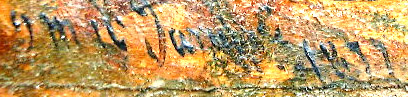
The vintage signature I.M.W. Turner R.A. 1817 (much enlarged) The key to the whole puzzle was found on the backing paper of its late nineteenth century frame. It was an inventory sticker, No. 157 - dated 1884. Besides being temporarily owned by Britpic and having uncertain auction markings on the backing paper, the only provenance the painting had was this shabby label with the name written in an exuberant script: “J’ rner R.A. Signed and dated from the collection of James (?).” The name on it had been read and advertised as James Crockling. But was that truly the name on the sticker?
While still waiting for the auction to end, I absorbed the information from the dealer’s write-up and pondered over the label. Suddenly I was jolted by the realization that the name was not Crockling, but, Orrock Esq. This was the same important collector of 18th and 19th century British art from whence Shipwreck, the Rescue sold in 1904.
 Label from the backing of the Orrock Ehrenbrietstein. “J… rner R.A. Signed and
dated from the collection of James Orrock Esq. No. 157 - 1884.”
The true provenance would likely not have been
recognized if I were not already familiar with the name’ “what a
coincidence! In a less secular society one would suspect providence.
Before the sale ended I had emailed Graham the image of the painting and label.
He felt the painting very Turnerian and without any prompting recognized the
name Orrock. His comment was: “don’t let this one get away.” The next day he was
busy at the University of British Columbia library; there he came up with a reference for the subject
of the painting. The
landscape and fortification on the mountain in the distance compared very
closely with a work Turner exhibited at the Royal Academy in 1835. In her 1995 exhibition catalogue, Turner in Germany,
Cecilia Powell wrote: “Turner depicted
Coblenz and Ehrenbrietstein many times in both pencil and watercolour between
1817 and the early 1840s, he produced only one oil painting of this subject:, ‘’’: The
Bright Stone of Honour (Ehrenbrietstein), and Tomb of Marceau’ this is one
of Turner’s most important depictions of Germany.” [v]
The landscape of the Orrock painting was certainly the same.
Label from the backing of the Orrock Ehrenbrietstein. “J… rner R.A. Signed and
dated from the collection of James Orrock Esq. No. 157 - 1884.”
The true provenance would likely not have been
recognized if I were not already familiar with the name’ “what a
coincidence! In a less secular society one would suspect providence.
Before the sale ended I had emailed Graham the image of the painting and label.
He felt the painting very Turnerian and without any prompting recognized the
name Orrock. His comment was: “don’t let this one get away.” The next day he was
busy at the University of British Columbia library; there he came up with a reference for the subject
of the painting. The
landscape and fortification on the mountain in the distance compared very
closely with a work Turner exhibited at the Royal Academy in 1835. In her 1995 exhibition catalogue, Turner in Germany,
Cecilia Powell wrote: “Turner depicted
Coblenz and Ehrenbrietstein many times in both pencil and watercolour between
1817 and the early 1840s, he produced only one oil painting of this subject:, ‘’’: The
Bright Stone of Honour (Ehrenbrietstein), and Tomb of Marceau’ this is one
of Turner’s most important depictions of Germany.” [v]
The landscape of the Orrock painting was certainly the same.
But how did this tie in with the date on the painting? As Powell mentioned, as early as 1817 Turner visited and sketched Ehrenbrietstein. The journey he mapped for himself meandered through the sight of the famous 1815, ‘’’: Battle of Waterloo’ and along the Rhine River. From what we know of Turner’s aesthetic judgment, although he was far from disappointed by the scenery in Germany, his first preference would have been to visit Italy and Rome once Napoleon was defeated and it was again safe to travel abroad. But because of his interest in the Allied victory, Byronic poetry associated with the area, and the British Institute competition encouraging artists to record the events surrounding the great victory, Turner had little choice but to take a journey with history painting in mind and leave the, ‘’’: picturesque’ for a future trip. “Turner’s wish to contribute to the great wave of paintings commemorating the recent victory which had been stimulated by a competition sponsored by the British Institution in 1816”[vi] was possibly the foremost reason for him to neglect Italy at that time. According to the Turner Bi-centenary exhibition catalogue: “Turner visited Ehrenbrietstein in 1819 and 1834 when he was planning a series of engravings of German rivers to follow the Rivers of France. A large sheet of paper in the British Museum, folded into 16 sections, bears a number of related drawings’ “[viii] These later sketches of Ehrenbrietstein combined with the 1817 material suggests that he had been planning a major exhibition piece of the region for several years. Finally, in 1835 he exhibited The Bright Stone of Honour (Ehrenbrietstein).

The Bright Stone of Honour (Ehrenbrietstein) and the Tomb of Marceau
Engraved version by J. Cousen
By studying the Orrock
Ehrenbrietstein it is evident that the, ‘’’: landscape’ aspect of the 1835 painting
(seen below)
resulted from Turner’s first visit to Coblentz and Ehrenbrietstein in 1817. To
make a cursory connection between oil-sketches and finished paintings we need
only defer to the Oxford Companion To J.M.W. Turner vis- -vis
Caernarvon Castle for which Turner “made a small oil study on panel, which
suggests that he first considered painting the subject in oils.”[ix]
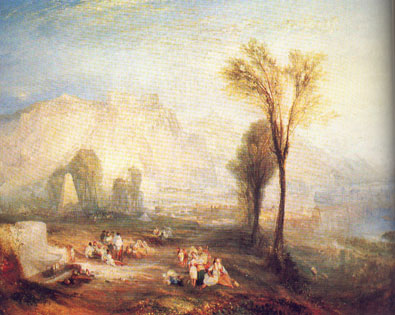 Without knowledge of the Orrock
painting it has been assumed that the exhibited piece of 1835 was inspired by
trips made years later but there are no related sketches to support this
hypothesis. It is unusual, that for such a complex piece as The Bright Stone
of Honour (Ehrenbrietstein) that there are no recognizable preliminary
drawings. Turner’s sketchbooks were the foundation for his studio work and to
produce such a major work from scratch would be unexpected’ “at least for the
topography of the landscape setting.
When comparing the similarity in
growth of the trees and surrounding foliage of both pictures, and the orientation of the
overall scene it becomes clear that the little oil-sketch is the logical
prototype. Particularly for the 1817, ‘’’: Rhine series’, Cecilia Powell confirms Turner’s reliance on his sketchbooks: “the fact is that each and every drawing can be matched
with a preparatory sketch or sketches in a sketchbook ’ " even down to such
details as the cows standing on the shore, a boat landing or linen spread out to
dry on a grassy bank.” [x]
From original settings he had
sketched from Nature Turner would often design an epic event to be
superimposed’ “and in this case, The Bright Stone of Honour
and the Tomb of Marceau. He did however frustrate his print
publishers at times with an overactive penchant for
invention. A conversation Turner had with Rev. William Kingsley over a
commission the artist had for Bible scenes makes this abundantly clear, “He told
me,” says Kingsley, " that the publishers thought he was mad, and required him
to put nothing into the drawings beyond what might actually be there.” [xi]
One further point
to consider
applies to the well-documented John Pye commission for engraving
Ehrenbrietstein. This was an exercise not to be taken lightly, for according
to Thornbury and substantiated by its late date of publication, it took Pye many
years to complete, “This picture was a subject chosen expressly by Mr. Pye to
engrave, and he devoted ten years to it.” [xii]
The timing of the debate between Turner and Pye over the size and delivery dates would
have precluded Turner gathering subsequent references, such as, more sketches
from abroad. He therefore already must have had some model in his possession for
the full-scale painting. As there are no other available candidates, the Orrock
picture stands alone as the topographical model. Jack Lindsay not only explains
that Turner used his oil sketches as models for larger studio works: “at times
he used his sketches for more elaborate oils,” but also, that “many of the works
he produced were complete in themselves, whatever his motive in making them.” [xiii]
At this point in time, at least some of the Tate Gallery people are unwilling to
accept that Turner did delicate small oil sketches, and although Martin Butlin admits that
there are several such works outside the Tate, over the years he and his staff
have avoided accepting them. Incongruously, one of these was originally from the Turner Bequest and is now in the British Museum.
If that one were in fact accepted, then the whole production of
Hand “C” would need
accepting. The problem with this scenario becomes apparent in the section,
Tribal Instincts.
Without knowledge of the Orrock
painting it has been assumed that the exhibited piece of 1835 was inspired by
trips made years later but there are no related sketches to support this
hypothesis. It is unusual, that for such a complex piece as The Bright Stone
of Honour (Ehrenbrietstein) that there are no recognizable preliminary
drawings. Turner’s sketchbooks were the foundation for his studio work and to
produce such a major work from scratch would be unexpected’ “at least for the
topography of the landscape setting.
When comparing the similarity in
growth of the trees and surrounding foliage of both pictures, and the orientation of the
overall scene it becomes clear that the little oil-sketch is the logical
prototype. Particularly for the 1817, ‘’’: Rhine series’, Cecilia Powell confirms Turner’s reliance on his sketchbooks: “the fact is that each and every drawing can be matched
with a preparatory sketch or sketches in a sketchbook ’ " even down to such
details as the cows standing on the shore, a boat landing or linen spread out to
dry on a grassy bank.” [x]
From original settings he had
sketched from Nature Turner would often design an epic event to be
superimposed’ “and in this case, The Bright Stone of Honour
and the Tomb of Marceau. He did however frustrate his print
publishers at times with an overactive penchant for
invention. A conversation Turner had with Rev. William Kingsley over a
commission the artist had for Bible scenes makes this abundantly clear, “He told
me,” says Kingsley, " that the publishers thought he was mad, and required him
to put nothing into the drawings beyond what might actually be there.” [xi]
One further point
to consider
applies to the well-documented John Pye commission for engraving
Ehrenbrietstein. This was an exercise not to be taken lightly, for according
to Thornbury and substantiated by its late date of publication, it took Pye many
years to complete, “This picture was a subject chosen expressly by Mr. Pye to
engrave, and he devoted ten years to it.” [xii]
The timing of the debate between Turner and Pye over the size and delivery dates would
have precluded Turner gathering subsequent references, such as, more sketches
from abroad. He therefore already must have had some model in his possession for
the full-scale painting. As there are no other available candidates, the Orrock
picture stands alone as the topographical model. Jack Lindsay not only explains
that Turner used his oil sketches as models for larger studio works: “at times
he used his sketches for more elaborate oils,” but also, that “many of the works
he produced were complete in themselves, whatever his motive in making them.” [xiii]
At this point in time, at least some of the Tate Gallery people are unwilling to
accept that Turner did delicate small oil sketches, and although Martin Butlin admits that
there are several such works outside the Tate, over the years he and his staff
have avoided accepting them. Incongruously, one of these was originally from the Turner Bequest and is now in the British Museum.
If that one were in fact accepted, then the whole production of
Hand “C” would need
accepting. The problem with this scenario becomes apparent in the section,
Tribal Instincts.
 Possibly for the sake of expedience, it
has been assumed in recent years that Turner did very little open-air sketching
using oil paint, mainly because he had told one of his colleagues that he could
do a substantially greater amount of image recording with pencil.
A couple of points that one might note here: the light source in the
Orrock Ehrenbrietstein as compared to that in The Bright Stone of Honour,
and the form of the tree in the center. The source of light
is indefinite in the 1835 picture, possible because the bright full moon has
been added, and in the 1817 Orrock picture the foreground
tree is more in keeping with the romance of his earlier work. Its spontaneous playfulness of form and sinuous nature reminds
us of stronger influences earlier in the century when the small oil would have
been painted. Turner had read “Hogarth before 1807’ The Analysis of Beauty,
which advocated the, ‘’’: serpentine line of beauty.’ “[xvi]
The way
in which
Turner’s work was evolving, even before his
first trip along the Rhine helps to shed light on the source of his inspiration.
Partly because of Sir Martin A. Shee, one of his popular colleagues who at the
time was successfully melding picture and verse, as well as through
encouragement of Sir Joshua Reynolds, Turner developed
the concept that the two art-forms were synonymous’ “one reinforcing the other. In
July of 1811 there was the “publication of the first two Cantos of Byron’s
Childe Harold’s Pilgrimage, a poem in which Turner seems to have perceived a
literary equivalent of his own vision. He was frequently to quote from it in
exhibition catalogues.” [xvii]
Turner’s seduction by Child
Harold’s phantasmagoric Pilgrimage[2]
is again seen two years later with his trip through Italy, “he had to enact for
himself the pilgrimage of Byron’s Child Harold in order to arrive at so complete
a statement of the classic myth of Italy…” [xviii]
That there was a direct connection with Turner’s 1817 oil-sketch and his journey
in Byron’s footsteps is certain. Turner left for the Rhine in August of 1817 and
Byron’s Canto III was published in November of 1816. One might assume that the poem
was the
inspiration for at least documenting an appropriate topography in 1817. One that was
ultimately used for the Bright Stone of Honour in which the French
Revolutionary General is the central theme. In his exhibited painting Turner
added the shrine in the form of an obelisk and included a
Byronic quote in deference to the General:
By Coblentz, on a rise of
gentle ground,
There is a small and
simple pyramid.
Crowning the summit of
the verdant mound;
Beneath its base are
heroes’ ashes hid,
Our enemy’s - but let
that not forbid
Honour to Marceau!
…
Brief, brave, and glorious
was his young career, -
His mourners were two
hosts, his friends and foes;
Pray for his gallant
spirit’s bright repose;
For he was freedom’s champion’
Possibly for the sake of expedience, it
has been assumed in recent years that Turner did very little open-air sketching
using oil paint, mainly because he had told one of his colleagues that he could
do a substantially greater amount of image recording with pencil.
A couple of points that one might note here: the light source in the
Orrock Ehrenbrietstein as compared to that in The Bright Stone of Honour,
and the form of the tree in the center. The source of light
is indefinite in the 1835 picture, possible because the bright full moon has
been added, and in the 1817 Orrock picture the foreground
tree is more in keeping with the romance of his earlier work. Its spontaneous playfulness of form and sinuous nature reminds
us of stronger influences earlier in the century when the small oil would have
been painted. Turner had read “Hogarth before 1807’ The Analysis of Beauty,
which advocated the, ‘’’: serpentine line of beauty.’ “[xvi]
The way
in which
Turner’s work was evolving, even before his
first trip along the Rhine helps to shed light on the source of his inspiration.
Partly because of Sir Martin A. Shee, one of his popular colleagues who at the
time was successfully melding picture and verse, as well as through
encouragement of Sir Joshua Reynolds, Turner developed
the concept that the two art-forms were synonymous’ “one reinforcing the other. In
July of 1811 there was the “publication of the first two Cantos of Byron’s
Childe Harold’s Pilgrimage, a poem in which Turner seems to have perceived a
literary equivalent of his own vision. He was frequently to quote from it in
exhibition catalogues.” [xvii]
Turner’s seduction by Child
Harold’s phantasmagoric Pilgrimage[2]
is again seen two years later with his trip through Italy, “he had to enact for
himself the pilgrimage of Byron’s Child Harold in order to arrive at so complete
a statement of the classic myth of Italy…” [xviii]
That there was a direct connection with Turner’s 1817 oil-sketch and his journey
in Byron’s footsteps is certain. Turner left for the Rhine in August of 1817 and
Byron’s Canto III was published in November of 1816. One might assume that the poem
was the
inspiration for at least documenting an appropriate topography in 1817. One that was
ultimately used for the Bright Stone of Honour in which the French
Revolutionary General is the central theme. In his exhibited painting Turner
added the shrine in the form of an obelisk and included a
Byronic quote in deference to the General:
By Coblentz, on a rise of
gentle ground,
There is a small and
simple pyramid.
Crowning the summit of
the verdant mound;
Beneath its base are
heroes’ ashes hid,
Our enemy’s - but let
that not forbid
Honour to Marceau!
…
Brief, brave, and glorious
was his young career, -
His mourners were two
hosts, his friends and foes;
Pray for his gallant
spirit’s bright repose;
For he was freedom’s champion’
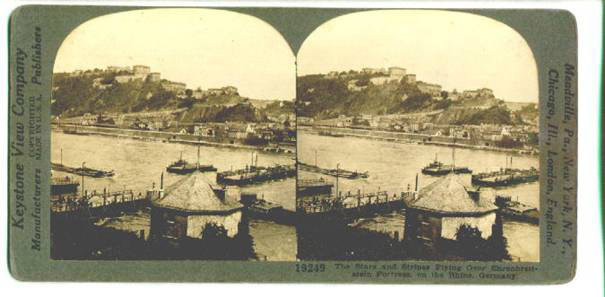 WWI stereo-view of
Ehrenbrietstein
from a similar vantage point
Another reference to General Marceau
might be indicated as early as 1817 by the symbolic inclusion of the cistern
seen in the foreground of both pictures.
Quoting from a book of poems by his friend Samuel Rogers, a book that Turner had
done illustrations for,
In the Crimea:
Drink and be glad. This
cistern of white stone, ———-
—— visit his tomb
with flowers;
And with a drop of this
sweet water fill
The two small cells
scooped in the marble there,
That birds may come and
drink upon his grave,
Making it holy,[3]
Such fountains are found along
the Rhine and are appreciated even today as places of pilgrimage in which to enjoy
the purifying waters. Turner may have intended this symbolic gesture from the
very beginning, but also, the cistern might have in fact existed and thus proven
a compounding source of inspiration.
The Orrock
Ehrenbrietstein
was painted at the leading edge of Turner’s, ‘’’: second
period’ of
artistic development, and the kind prose Thornbury had for this middle period is
very fitting:
“The chief
characteristics of this period are colour instead of grey, refinement instead
of force, quantity instead of mass. His light is now as near the brightness
of real light as possible; his shadow not of one colour, but of various colours.
He tries now for delicacy and tenderness of contrast instead of violence’ [4]
the drawings of this period, when not painted for display, are ‘faultless and
magnificent.’ The splendour and gladness of the world, not its humiliation and
pain, are now his chief object.” [xix]
This description is fitting for
the little Ehrenbrietstein but apparently not for any small oil-sketches
in the Tate / Clore Gallery Turner Bequest. Could this be the reason that
the officials there are reticent to accept work of:
“refinement, delicacy and tenderness?” What should one think of Thornbury’s
quote in light of Butlin’s invention of the nefarious Hand
C, “distinguished by the small size of the paintings, in oils, and by an
over-delicate prettification of Turnerian style and motifs?” (Oxford Companion to J.M.W. Turner
)
Helen Conant supports Thornbury: “refinement takes the
place of force. He had discovered that it is much more difficult to draw
tenderly than ponderously, and that all the most beautiful things in nature
depend on infinitely delicate lines.” [xx]
Ruskin was emphatic when he lists the dramatic change to Turner’s middle
period style:
WWI stereo-view of
Ehrenbrietstein
from a similar vantage point
Another reference to General Marceau
might be indicated as early as 1817 by the symbolic inclusion of the cistern
seen in the foreground of both pictures.
Quoting from a book of poems by his friend Samuel Rogers, a book that Turner had
done illustrations for,
In the Crimea:
Drink and be glad. This
cistern of white stone, ———-
—— visit his tomb
with flowers;
And with a drop of this
sweet water fill
The two small cells
scooped in the marble there,
That birds may come and
drink upon his grave,
Making it holy,[3]
Such fountains are found along
the Rhine and are appreciated even today as places of pilgrimage in which to enjoy
the purifying waters. Turner may have intended this symbolic gesture from the
very beginning, but also, the cistern might have in fact existed and thus proven
a compounding source of inspiration.
The Orrock
Ehrenbrietstein
was painted at the leading edge of Turner’s, ‘’’: second
period’ of
artistic development, and the kind prose Thornbury had for this middle period is
very fitting:
“The chief
characteristics of this period are colour instead of grey, refinement instead
of force, quantity instead of mass. His light is now as near the brightness
of real light as possible; his shadow not of one colour, but of various colours.
He tries now for delicacy and tenderness of contrast instead of violence’ [4]
the drawings of this period, when not painted for display, are ‘faultless and
magnificent.’ The splendour and gladness of the world, not its humiliation and
pain, are now his chief object.” [xix]
This description is fitting for
the little Ehrenbrietstein but apparently not for any small oil-sketches
in the Tate / Clore Gallery Turner Bequest. Could this be the reason that
the officials there are reticent to accept work of:
“refinement, delicacy and tenderness?” What should one think of Thornbury’s
quote in light of Butlin’s invention of the nefarious Hand
C, “distinguished by the small size of the paintings, in oils, and by an
over-delicate prettification of Turnerian style and motifs?” (Oxford Companion to J.M.W. Turner
)
Helen Conant supports Thornbury: “refinement takes the
place of force. He had discovered that it is much more difficult to draw
tenderly than ponderously, and that all the most beautiful things in nature
depend on infinitely delicate lines.” [xx]
Ruskin was emphatic when he lists the dramatic change to Turner’s middle
period style:
- Colour takes the place of grey.
- Refinement takes the place of force.
- Quantity takes the place of mass. “He had discovered that it is much more difficult to draw tenderly than ponderously, and that all the most beautiful things in nature depend on infinitely delicate lines. His effort is, therefore, always, now, to trace lines as finely, and shades as softly, as the point of the brush and feeling of the hand are capable of doing; and the effects sought are themselves the most subtle and delicate which nature presents.” (Ruskin, Turner Gallery at Marlborough House) Turner’s second biographer, Hamerton, who was himself an artist’ “surely more aware of artistic technique than Thornbury and likely on par with Ruskin, concurs: “Turner did not despise detail, but finished all his work sufficiently and some of it minutely; that he wrought for colour as much as form, tenderly, delicately, and therefore (however swiftly) without hurry.” [xxi] With Turner’s move into this phase of his art production, which was so dominated by his print production, Wilkinson uses the expression, “new sensitivity.” [xxii] Perhaps one should be less hasty in trying to excluded such work; there is one delicate work in the British Museum collection that some Tate pundits seem to have ganged-up against. It is a slight bit smaller than the Orrock Ehrenbrietstein and is certainly in keeping with Martin Butlin’s Hand C theory. The BJ catalogue entry that renders it a “dud” indicates that previously it was highly revered’ “exhibited more than once in fact. This is telling; it confirms that outside Martin’s friendly circle his hand theory might not be widely accepted. The BJ 551a entry is as follows, a Landscape with Distant Church: “Despite having been selected for exhibition and numbering (782) by the National Gallery in the late 1860s this work does not seem to be by Turner; the forms and execution are altogether too delicate and precise. Andrew Wilton [Martin’s successor at the Tate] agrees with this verdict (verbal confirmation) though Ziff accepts the work as genuine.”[xxiii] This previously revered work is dejected alas. Will there not be a reprieve for at least one single reference to the more sensitive side of Turner during this period of “new sensitivity?”
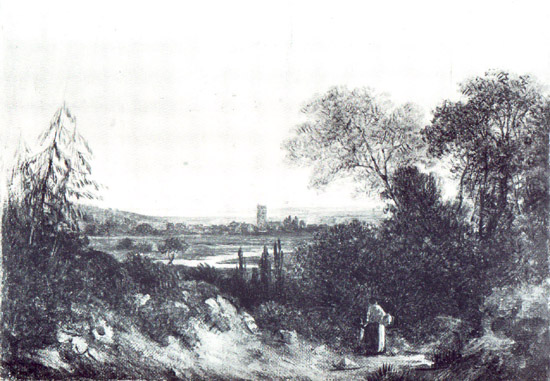 Landscape with
Distant Church 8.5 x 10.5 inches from the British
Museum (presently rejected by Martin Butlin)
This
certainly shows Martin’s ability to change the status of a widely
accepted work, on the slightest, or might we say the most “delicate” of whims.
All in all, it was likely necessary for the devolution of the little oil in
order that the supply of Turner’s work did not get out of hand. If it
were acknowledged as being
“right,” its acceptance would have given credence to all those other, now condemned, small delicate
oils. This painting that is now in limbo, Landscape with Distant Church
was in fact from Turner’s own studio and formed part of the Turner Bequest.
Dare we say, then’ “so much for the merit of that particular sort of provenance!
Turner’s manner of production is known to be broad with at least three distinct
style changes taking place along the way.
The somewhat more sensitive period in Turner’s production would seem to coincide
with the dates Michael Kitson gives for Turner’s calm pictures. In his words:
“From about 1807 until his departure for Italy in 1819 he produced an increasing
number of calm pictures, he did this in his work in all styles, not only in
pictures directly inspired by Claude.” (M.
Kitson, 1964, p. 16.) It is not so much the delicacy of
production, or size of the work that one should be looking at, so much as, “the
uniting link of character; [it] is never lost.” [xxiv]
It makes little sense to believe that there would be an independent class
of Turner fakes in any case.
It was the first hand experience
of Charles Eastlake that alerts one to expectations of finding many oil sketches
done by Turner. “When the executors were examining his boxes after his death,
they suddenly came upon several oil sketches., ‘’’: Now,’ said Sir Charles Eastlake,
, ‘’’: we shall find many more of these, for I remember being with Turner once, in
Devonshire when he made sketches in oil.’ But no more were found.” [xxv]
Many years earlier while with
Cyrus Redding Turner played host in a picnic setting. This of course was
somewhat out of character for Turner who was so often portrayed ascetically,
with little but art on his mind. Thornbury gives us Redding’s reminiscences of
the occasion:
“I was of a party to
whom Turner had given a picnic in Devonshire’ There were eight or nine of the
party, including some ladies. Turner, with an ample supply of cold meats, shell
fish, and wines was there before us. In that delightful spot we spent the better
part of a delightful summer’s day. Never was there more social pleasure partaken
by any party in that English Eden. Turner was exceedingly agreeable for one
whose language was more epigrammatic and terse than complimentary upon most
occasions. He had come two or three miles with the man who bore his store of
good things, and had been at work before our arrival. He showed the ladies some
of his sketches in oil, which he had brought with him, perhaps, to verify them.
The wine circulated freely’ “[xxvi]
This sounds closer to a private gallery exhibition opening-gala than a
picnic. This is a story that has been often repeated but without emphasis on a
key element of the story’ “Turner’s sketches in oil. Specially selected to impress
the ladies, they certainly would not have been anything slapdash, and
considering the setting they were likely to be of an intimate size. They were
likely the oil version of his highly finished and saleable work in watercolour,
small and portable, otherwise; some finished watercolours would have been a
better choice for the occasion. One might ask, where on earth are these
oil-sketches now? Condemned perhaps–relegated to an obscure category of duds? Is it possible that
Turner, the ever-shrewd businessman wanted more than “verification” of his work
that day of the picnic, he had never in the past gone to anyone for
encouragement. It is likely he was there to garner interest and possibly sell
the paintings. And if this were the case there would have been little attention given to
documentary details, receipts, and the like.
Landscape with
Distant Church 8.5 x 10.5 inches from the British
Museum (presently rejected by Martin Butlin)
This
certainly shows Martin’s ability to change the status of a widely
accepted work, on the slightest, or might we say the most “delicate” of whims.
All in all, it was likely necessary for the devolution of the little oil in
order that the supply of Turner’s work did not get out of hand. If it
were acknowledged as being
“right,” its acceptance would have given credence to all those other, now condemned, small delicate
oils. This painting that is now in limbo, Landscape with Distant Church
was in fact from Turner’s own studio and formed part of the Turner Bequest.
Dare we say, then’ “so much for the merit of that particular sort of provenance!
Turner’s manner of production is known to be broad with at least three distinct
style changes taking place along the way.
The somewhat more sensitive period in Turner’s production would seem to coincide
with the dates Michael Kitson gives for Turner’s calm pictures. In his words:
“From about 1807 until his departure for Italy in 1819 he produced an increasing
number of calm pictures, he did this in his work in all styles, not only in
pictures directly inspired by Claude.” (M.
Kitson, 1964, p. 16.) It is not so much the delicacy of
production, or size of the work that one should be looking at, so much as, “the
uniting link of character; [it] is never lost.” [xxiv]
It makes little sense to believe that there would be an independent class
of Turner fakes in any case.
It was the first hand experience
of Charles Eastlake that alerts one to expectations of finding many oil sketches
done by Turner. “When the executors were examining his boxes after his death,
they suddenly came upon several oil sketches., ‘’’: Now,’ said Sir Charles Eastlake,
, ‘’’: we shall find many more of these, for I remember being with Turner once, in
Devonshire when he made sketches in oil.’ But no more were found.” [xxv]
Many years earlier while with
Cyrus Redding Turner played host in a picnic setting. This of course was
somewhat out of character for Turner who was so often portrayed ascetically,
with little but art on his mind. Thornbury gives us Redding’s reminiscences of
the occasion:
“I was of a party to
whom Turner had given a picnic in Devonshire’ There were eight or nine of the
party, including some ladies. Turner, with an ample supply of cold meats, shell
fish, and wines was there before us. In that delightful spot we spent the better
part of a delightful summer’s day. Never was there more social pleasure partaken
by any party in that English Eden. Turner was exceedingly agreeable for one
whose language was more epigrammatic and terse than complimentary upon most
occasions. He had come two or three miles with the man who bore his store of
good things, and had been at work before our arrival. He showed the ladies some
of his sketches in oil, which he had brought with him, perhaps, to verify them.
The wine circulated freely’ “[xxvi]
This sounds closer to a private gallery exhibition opening-gala than a
picnic. This is a story that has been often repeated but without emphasis on a
key element of the story’ “Turner’s sketches in oil. Specially selected to impress
the ladies, they certainly would not have been anything slapdash, and
considering the setting they were likely to be of an intimate size. They were
likely the oil version of his highly finished and saleable work in watercolour,
small and portable, otherwise; some finished watercolours would have been a
better choice for the occasion. One might ask, where on earth are these
oil-sketches now? Condemned perhaps–relegated to an obscure category of duds? Is it possible that
Turner, the ever-shrewd businessman wanted more than “verification” of his work
that day of the picnic, he had never in the past gone to anyone for
encouragement. It is likely he was there to garner interest and possibly sell
the paintings. And if this were the case there would have been little attention given to
documentary details, receipts, and the like.
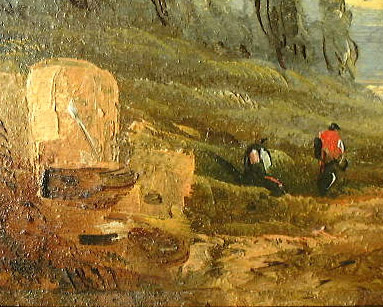 Orrock Ehrenbrietstein
enlarged detail showing two figures and the fountain
More than anyone, Sir Charles Eastlake, President of the Royal Academy gave
Thornbury confirmation that Turner sketched repeatedly with oils and was
apparently excited when people acknowledged the speed by which he did so. And
although he most often hid his working methods, it is clear from Eastlake’s
remarks that Turner wanted people to know that he could easily switch from
pencil to the brush for outdoor studies. Here is how Thornbury recorded it:
“Mr. Johns fitted a
small portable painting box, containing some prepared paper for oil sketches, as
well as the other necessary materials. When Turner halted at a scene and seemed
inclined to sketch it, Johns produced the inviting box, and the great artist,
finding everything ready to his hand, immediately began to work’ after a few
days he made his oil sketches freely in our presence. Johns accompanied him
always; I was only with them occasionally. Turner seemed pleased when the
rapidity with which those sketches were done was talked of; for, departing from
his habitual reserve in the instance of his pencil sketches, he made no
difficulty in showing them. On one occasion, when, on his return after a
sketching ramble, to a country residence belonging to my father, near Plymouth,
the day’s work was shown, he himself remarked that one of the sketches (and
perhaps the best) was done in less than half an hour.
“, ‘’’: Long afterwards, the great painter sent Johns in a
letter a small oil sketch, not painted from nature, as a return for his kindness
and assistance.’”[xxvii]
In the case of these particular
sketches that Eastlake was later “snooping” after, the President himself found it difficult
to believe they became waste as Turner had suggested. This, considering that Turner was
careful to preserve even the grubbiest little scrap for later reference. These
sketches might have eventually been removed surreptitiously from the late Turner’s studio
or at some point been sold by the artist himself. Yet why are they, along with the
little oil sketch sent in the letter to Johns, nowhere to be found in Turner
catalogues?
It might be interesting here to reflect on the point that Turner could paint a
small oil painting in half an hour. With this in mind why is there such a dearth
of oil paintings listed by Butlin and Joll, only about five hundred? The painter
of monumental works on the grandest scale, international diplomat, and family
man’ “Rubens, has three thousand to his credit! Although, Rubens had a number of
helpers; he lived fewer years than Turner, and was often away from his studio on
non art-related business. Even if
Turner’s finely finished water colours were considered on-par with oil painting
generally, the expected number still falls short. It appears likely that efforts to exclude works
from
the artist’s oeuvre have been over-zealous.
Orrock Ehrenbrietstein
enlarged detail showing two figures and the fountain
More than anyone, Sir Charles Eastlake, President of the Royal Academy gave
Thornbury confirmation that Turner sketched repeatedly with oils and was
apparently excited when people acknowledged the speed by which he did so. And
although he most often hid his working methods, it is clear from Eastlake’s
remarks that Turner wanted people to know that he could easily switch from
pencil to the brush for outdoor studies. Here is how Thornbury recorded it:
“Mr. Johns fitted a
small portable painting box, containing some prepared paper for oil sketches, as
well as the other necessary materials. When Turner halted at a scene and seemed
inclined to sketch it, Johns produced the inviting box, and the great artist,
finding everything ready to his hand, immediately began to work’ after a few
days he made his oil sketches freely in our presence. Johns accompanied him
always; I was only with them occasionally. Turner seemed pleased when the
rapidity with which those sketches were done was talked of; for, departing from
his habitual reserve in the instance of his pencil sketches, he made no
difficulty in showing them. On one occasion, when, on his return after a
sketching ramble, to a country residence belonging to my father, near Plymouth,
the day’s work was shown, he himself remarked that one of the sketches (and
perhaps the best) was done in less than half an hour.
“, ‘’’: Long afterwards, the great painter sent Johns in a
letter a small oil sketch, not painted from nature, as a return for his kindness
and assistance.’”[xxvii]
In the case of these particular
sketches that Eastlake was later “snooping” after, the President himself found it difficult
to believe they became waste as Turner had suggested. This, considering that Turner was
careful to preserve even the grubbiest little scrap for later reference. These
sketches might have eventually been removed surreptitiously from the late Turner’s studio
or at some point been sold by the artist himself. Yet why are they, along with the
little oil sketch sent in the letter to Johns, nowhere to be found in Turner
catalogues?
It might be interesting here to reflect on the point that Turner could paint a
small oil painting in half an hour. With this in mind why is there such a dearth
of oil paintings listed by Butlin and Joll, only about five hundred? The painter
of monumental works on the grandest scale, international diplomat, and family
man’ “Rubens, has three thousand to his credit! Although, Rubens had a number of
helpers; he lived fewer years than Turner, and was often away from his studio on
non art-related business. Even if
Turner’s finely finished water colours were considered on-par with oil painting
generally, the expected number still falls short. It appears likely that efforts to exclude works
from
the artist’s oeuvre have been over-zealous.
In addition to the Historical significance of the 1935 version of Ehrenbrietstein, Turner also added a moon! Might this bit of Romance have been spawned by Byron’s own vision?
The moon is up, and yet it is not night, The sun as yet divides the day with her.
Lord Byron
In fact, if it were not for the
Orrock Ehrenbrietstein, one would likely not recognize so readily that the primary
illumination of the sun comes from behind the tree.
Alas, Turner’s use of oil paint during his short trip to Germany in 1817
presents us with somewhat of a quandary. How did Turner make enough time during
his pedestrian travels to allow for the necessary drying time? The answer might
be that he painted the Orrock Ehrenbrietstein on the way to Mainz, and
picked it up at the same hotel he was known to have stayed at, in Coblenz, on the way back
the following week. This was adjacent to Ehrenbrietstein. And if he brought the
paints with him to Germany, one might eventually expect other small Rhineland scenes to surface, otherwise,
we can only assume that the paints were acquired or borrowed en-route. It was
mentioned in his, ‘’’: Itinerary Rhine’ that he did take along colours.
Wilkinson confirms this, but questions “Whether he used these colours on the
tour’ He lost them on the way back, according to a note in a later book.” [xxxi]
Turner knew he would be
returning to Coblenz within the week, therefore it is likely that he left some
of his travel gear at the hotel in Coblenz to be claimed on his return. Might this untoward
risk have been the reason Turner lost his backpack-styled, ‘’’: wallet’ which
contained much of his kit. In her thorough study of Turner’s travels through
Germany, Cecilia Powell sympathized that, “The most irritating items to have
lost must have been the guide books and drawing materials which included his
interleaved copy of Campbell’s Guide through Belgium and Holland, half a
dozen pencils and a box of colours; but it must also have been somewhat
inconvenient to have lost his razor, nightshirt, spare umbrella ferrule,
stockings, cravats, waistcoat and a supply of clean shirts.”[xxxi]
Agreed, it is logistically a
difficult question; but if the small Ehrenbrietstein were not painted on
the actual tour, it would have been worked-up in London or Raby Castle shortly
afterwards. This would be in keeping with contemporary opinion about the other
fifty-odd watercolours of the same region that Walter Fawkes bought shortly after Turner’s return
home. The oil-sketch did however have to eventually reside in London to be used
as the model for the 1835 exhibition piece, and the 1817 inscription, must
indicate that it was done within a few months of the journey.
 The oil sketch of Devonshire from
1813 (seen here) was illustrated in W.L. Wyllie’s biography of Turner, page 54.
It is
effectively the same size as Orrock’s Ehrenbrietstein and it is certainly
as delicate. Both seem in keeping with the Hand C concept. Clearly, this
Devonshire painting has been so well traveled, and exhibited, that there is no
denying that it is by the hand of Turner. It is part of a 1813 series of small
oil sketches that Turner left in various stages of completion. The paper could quite
feasibly have come from the same sketchbook as the Orrock picture. They are the same size
and reasonably close in date.
In the introduction to
The Paintings of J.M.W. Turner, the Butlin and Joll catalogue raisonn (c), it is almost as
though Evelyn Joll anticipated the discovery of works such as Orrock’s
Ehrenbrietstein. He wrote that: “Apart from the series of small oil sketches executed in
Devon in 1813, studies in oil, made out of doors, occur very rarely thereafter
so far as we know, but Turner was prepared to employ any methods that lay at
hand in order to capture an effect, so that one must be wary of being too
dogmatic about this.” [xxxii]
The following excerpt quoted from a conversation in Turner’s studio shortly
after his passing reminds us that, yes, there were many more such sketches to be
found: “, ‘’’: Now,’ said Sir Charles Eastlake,, ‘’’: we shall find many more of these…
‘”
The unusual hatching technique Turner used to render the grass as seen in the
foreground of the Orrock Ehrenbrietstein is seen several places in the
Devonshire series as well.
Evelyn Joll’s statement is somewhat supportive of the little oil sketch, but at
the same time expresses a deeper sentiment, and the core reason for the many
roadblocks modern connoisseurship is confronted with’ “timorous dogmatism by the
curatorial community. It makes one
wonder if this oxymoron might be rooted in some esoteric church of pessimism. Or
is it caused by the ever looming legal threat of litigation; it may only be an
unconscious way of life motivated by little more than training. From one or a
combination of these reasons, one might assume that
Evelyn Joll in late life wisely concluded that the rejection of small, more carefully rendered
oil-sketches, was ungrounded?
If Martin Butlin truly believes that works in the style of Hand C are not by
Turner, and is unwilling to abandon his youthful invention, the least one would
hope is that those same anonymous creators might be classified properly. They cannot
honestly be called fakers and forgers because apparently most of their
work is unsigned. If there had in the beginning been an attempt to deceive, there would
be more than stylistic similarities to base a condemnation on. If these
abandoned works were in fact signed “Turner,” those
who wished to disparage them and their creator could then justly ply whatever cruel nomenclature deemed
appropriate.
There is one other glaring discrepancy about the shadowy thought that the
Orrock Ehrenbrietstein might be a product of a late 19th
century, ‘’’: imitator’. It is the vintage signature and date. It would be a
misguided imitator or faker, if he were dating a picture 1817, while nineteenth century
Turner biographers all believe that the final exhibition piece, c1835, derived from
journeys made decades later. It would be foolhardy for a 19th century
imitator to try and rewrite history and at the same time pass off a forgery.
Yes, if the piece were not right, by having a signature it would automatically
become an outright forgery. Again, it is very unlikely that a faker trying to
fraudulently deceive would immediately give himself or herself away with an
incredulous date.
If a faker were using one of the only two available images for a model: the
exhibited painting, or the engravings of it, which are certainly all dated circa
1835 or later, and the faker dated the “imitation” accordingly, the attempted
deception would have appeared more rational. Another reason it seems illogical
for a faker to use the date of 1817, is that, until more modern scholarship was
available Turner’s trip to Germany in 1817 was not general knowledge. Thornbury
had him going to the Rhine for the first time in 1819, two years later than the
actual trip, and even the Tate Bicentenary publication Turner 1775-1851,
as late as 1974 was using this same erroneous date of 1819.
(p.143)
In 1902, Swinburne tells us that, “Turner made a second tour to the
Continent in 1813, and a third in 1819."(Swinburne, 1902, p162)
There were
several Turner scholars before 1974 that did discover the true date of
Turner’s first trip to Italy, 1817, and this was likely by means of an independent review
of Turner’s sketchbooks after they became accessible. Not the least of who
was A.J. Finberg, who in 1904 was probably the first. A. J. Finberg pronounced in
his book:
“The foundations of this Chronicle were laid in 1904, when Mr. Hawes Turner, who
was then Keeper and Secretary of the National Gallery, allowed me to explore the
contents of the eleven large deed-boxes in which what had come to be regarded as
“the waste-paper basket” of Turner’s workshop had been preserved from the eyes
of the profane for nearly fifty years.” (Finberg, 1939,
preface)
This was many years
after Thornbury and many years after the Orrock Ehrenbrietstein could have
been painted. The true 1817 date would certainly have evaded any 19th century
“faker.” The Tate dating faux-pas in 1974 was not an isolated instance in recent history.
In the catalogue for the 1963-64 multi-venue exhibition held in America,
Turner Watercolors from The British Museum, the Keeper of Prints and
Drawings wrote that, “Turner did not take immediate advantage of the reopening
of the Continent to the English traveler after Waterloo, and it was not until
1819 that he made his second journey abroad."[Edward
Croft-Murray, Turner Watercolors from The British Museum,
(Smithsonian Publication No. 4519, 1963), 10]
|
The quirky nature by which the
truth unfolded gave the only clue strong enough to challenge, ‘’’: the
invention’ of the man with the many-hands
The oil sketch of Devonshire from
1813 (seen here) was illustrated in W.L. Wyllie’s biography of Turner, page 54.
It is
effectively the same size as Orrock’s Ehrenbrietstein and it is certainly
as delicate. Both seem in keeping with the Hand C concept. Clearly, this
Devonshire painting has been so well traveled, and exhibited, that there is no
denying that it is by the hand of Turner. It is part of a 1813 series of small
oil sketches that Turner left in various stages of completion. The paper could quite
feasibly have come from the same sketchbook as the Orrock picture. They are the same size
and reasonably close in date.
In the introduction to
The Paintings of J.M.W. Turner, the Butlin and Joll catalogue raisonn (c), it is almost as
though Evelyn Joll anticipated the discovery of works such as Orrock’s
Ehrenbrietstein. He wrote that: “Apart from the series of small oil sketches executed in
Devon in 1813, studies in oil, made out of doors, occur very rarely thereafter
so far as we know, but Turner was prepared to employ any methods that lay at
hand in order to capture an effect, so that one must be wary of being too
dogmatic about this.” [xxxii]
The following excerpt quoted from a conversation in Turner’s studio shortly
after his passing reminds us that, yes, there were many more such sketches to be
found: “, ‘’’: Now,’ said Sir Charles Eastlake,, ‘’’: we shall find many more of these…
‘”
The unusual hatching technique Turner used to render the grass as seen in the
foreground of the Orrock Ehrenbrietstein is seen several places in the
Devonshire series as well.
Evelyn Joll’s statement is somewhat supportive of the little oil sketch, but at
the same time expresses a deeper sentiment, and the core reason for the many
roadblocks modern connoisseurship is confronted with’ “timorous dogmatism by the
curatorial community. It makes one
wonder if this oxymoron might be rooted in some esoteric church of pessimism. Or
is it caused by the ever looming legal threat of litigation; it may only be an
unconscious way of life motivated by little more than training. From one or a
combination of these reasons, one might assume that
Evelyn Joll in late life wisely concluded that the rejection of small, more carefully rendered
oil-sketches, was ungrounded?
If Martin Butlin truly believes that works in the style of Hand C are not by
Turner, and is unwilling to abandon his youthful invention, the least one would
hope is that those same anonymous creators might be classified properly. They cannot
honestly be called fakers and forgers because apparently most of their
work is unsigned. If there had in the beginning been an attempt to deceive, there would
be more than stylistic similarities to base a condemnation on. If these
abandoned works were in fact signed “Turner,” those
who wished to disparage them and their creator could then justly ply whatever cruel nomenclature deemed
appropriate.
There is one other glaring discrepancy about the shadowy thought that the
Orrock Ehrenbrietstein might be a product of a late 19th
century, ‘’’: imitator’. It is the vintage signature and date. It would be a
misguided imitator or faker, if he were dating a picture 1817, while nineteenth century
Turner biographers all believe that the final exhibition piece, c1835, derived from
journeys made decades later. It would be foolhardy for a 19th century
imitator to try and rewrite history and at the same time pass off a forgery.
Yes, if the piece were not right, by having a signature it would automatically
become an outright forgery. Again, it is very unlikely that a faker trying to
fraudulently deceive would immediately give himself or herself away with an
incredulous date.
If a faker were using one of the only two available images for a model: the
exhibited painting, or the engravings of it, which are certainly all dated circa
1835 or later, and the faker dated the “imitation” accordingly, the attempted
deception would have appeared more rational. Another reason it seems illogical
for a faker to use the date of 1817, is that, until more modern scholarship was
available Turner’s trip to Germany in 1817 was not general knowledge. Thornbury
had him going to the Rhine for the first time in 1819, two years later than the
actual trip, and even the Tate Bicentenary publication Turner 1775-1851,
as late as 1974 was using this same erroneous date of 1819.
(p.143)
In 1902, Swinburne tells us that, “Turner made a second tour to the
Continent in 1813, and a third in 1819."(Swinburne, 1902, p162)
There were
several Turner scholars before 1974 that did discover the true date of
Turner’s first trip to Italy, 1817, and this was likely by means of an independent review
of Turner’s sketchbooks after they became accessible. Not the least of who
was A.J. Finberg, who in 1904 was probably the first. A. J. Finberg pronounced in
his book:
“The foundations of this Chronicle were laid in 1904, when Mr. Hawes Turner, who
was then Keeper and Secretary of the National Gallery, allowed me to explore the
contents of the eleven large deed-boxes in which what had come to be regarded as
“the waste-paper basket” of Turner’s workshop had been preserved from the eyes
of the profane for nearly fifty years.” (Finberg, 1939,
preface)
This was many years
after Thornbury and many years after the Orrock Ehrenbrietstein could have
been painted. The true 1817 date would certainly have evaded any 19th century
“faker.” The Tate dating faux-pas in 1974 was not an isolated instance in recent history.
In the catalogue for the 1963-64 multi-venue exhibition held in America,
Turner Watercolors from The British Museum, the Keeper of Prints and
Drawings wrote that, “Turner did not take immediate advantage of the reopening
of the Continent to the English traveler after Waterloo, and it was not until
1819 that he made his second journey abroad."[Edward
Croft-Murray, Turner Watercolors from The British Museum,
(Smithsonian Publication No. 4519, 1963), 10]
|
The quirky nature by which the
truth unfolded gave the only clue strong enough to challenge, ‘’’: the
invention’ of the man with the many-hands

The great irony with Thornbury’s original 1819 dating, is that, if it were not for his mistake, the Butlin Hand Theory might have become more and more an unassailable proposition. The quirky nature by which the truth unfolded gave the only clue strong enough to challenge, ‘’’: the invention’ of the man with the many-hands. And for those who rapaciously condemn Thornbury’s efforts, we should be able to comfortably assume that on occasion good can derive from a small blunder. For all we know this same erroneous date might have made it possible to Rescue an entire class of Turner’s work, and some of his finer jewels at that. Orrock Ehrenbrietstein discussion from the Butlin visit. Orrock Provenance The Unknown Turner Tribal Instincts Connoisseurship
HOME [1] The marbled design of the book board compares favorably with other Turner sketchbooks. [2] This pilgrimage and inspiration for the epic poem Pilgrimage of Childe Harold by Lord Byron started early in th19th century with his trip down the Rhine and through Italy. [3] The source of Rogers’ inspiration is said to be a Turkish superstition. [4] The italics are the author’s.
[i] Frank Herrmann, Sotheby’s, Portrait of an Auction House, (Chatto and Windus, London, 1980), 397-8. [ii] Ibid. 425. [iii] Walter Thornbury, The Life of J.M.W. Turner, (Hurst and Blackett, Publishers, London, 1862), vol. 2, 312. [iv] Ibid. vol. I, 174. [v] Cecilia Powell, Turner in Germany, (Tate Gallery Publications, London, 1995), 181. [vi] John Gage, J. M. W. Turner: A Wonderful Range of Mind, (London, Yale University Press, 1987), 44. [vii] Ibid, 61. [viii] Tate Gallery, Turner, (London: Tate Gallery Publishing, 1974), 143. [ix] Andrew Wilton, The Oxford Companion To J.M.W. Turner, (Oxford University Press Inc., New York, Evelyn Joll, Martin Butlin, and Luke Herrmann, 2001), 37. [x] Cecilia Powell, Turner in Germany, (Tate Gallery Publications, London, 1995), 27. [xi] Mordechai Omer, Turner and The Bible, (Israel Museum, Jerusalem, 1979), 8. [xii] Walter Thornbury, Life of J. M. W. Turner, R.A., (Hurst and Blackett, Publishers, London, 1862), vol. 1, 326-7. [xiii] Jack Lindsay, J. M. W. Turner, A Critical Biography, (New York Graphic Society, Greenwich, Connecticut, 1966), 101. [xiv] W. L. Wyllie A.R.A., J.M.W. Turner, (G. Bell & Sons, London, 1905), 67. [xv] Luke Herrmann, Turner, Paintings, Watercolours, Prints & Drawings, (Phaidon Press Limited, London, 1975), 22. [xvi] Eric Shanes, J.M.W. Turner, The Foundations of Genius, (The Taft Museum Cincinnati, Ohio; Corbett Foundation; The Hennegan Co. printers, 1986), 20. [xvii] Andrew Wilton,, ‘’’: Turner in his time’. (New York: Harry N. Abrams, Incorporated, 1987), 124. [xviii] Ibid. 146. [xix] Walter Thornbury, Life of J. M. W. Turner, R.A., (Hurst and Blackett, Publishers, London, 1862), vol. 1, 259-60; also see pp. 356. [xx] Helen S. Conant, J.M.W. Turner, (extract from Harper’s Monthly Magazine: 1878; published in Master-In-Art series by Bates and Guild Company, Boston, nov 1902), 27. [xxi] Philip Gilbert Hamerton, Life of J.M.W. Turner R.A., (University Press: John Wilson & Son, Cambridge, 1879), 365. [xxii] Gerald Wilkinson, Turner Sketches 1789-1820, (Barrie & Jenkins Ltd., London, 1977), 138. [xxiii] Martin Butlin & Evelyn Joll, The Paintings of J.M.W. Turner, (Yale University Press, New Haven and London, Evelyn Joll’s 1977 intro. Revised Edition, 1984), text vol, 317. [xxiv] Frances Tyrrell-Gill, Little Books On Art: Turner, (Methuen & Co., London, 1904), 102. [xxv] Walter Thornbury, Life of J. M. W. Turner, R.A., (Hurst and Blackett, Publishers, London, 1862), vol.1, 151. [xxvi] Walter Thornbury, Life of J. M. W. Turner, R.A., (Hurst and Blackett, Publishers, London, 1862), vol. 1, 216. [xxvii] Ibid. 220. [xxviii] John Gage, Colour in Turner: Poetry and Truth, (Studio Vista Limited, 1969), 39. also Thornbury, vol. 1, pp. 151. [xxix] Cecilia Powell, Turner in Germany, (Tate Gallery Publications, London, 1995), 90. [xxx] Gerald Wilkinson, Turner Sketches 1789-1820, (Barrie & Jenkins Ltd., London, 1977), 143-4. [xxxi] Ibid. 142; also see, Cecilia Powell, Turner’s Rivers of Europe, (Tate Gallery, sponsored by Volkswagon, 1991), 26. [xxxii] Martin Butlin & Evelyn Joll, The Paintings of J.M.W. Turner, (Yale University Press, New Haven and London, Evelyn Joll’s 1977 intro. Revised Edition, 1984), text vol., xvi.
| An introduction: JMW Turner Rescue
off site: Turner Society Tate Gallery National Gallery London Courtauld Institute of Art IFAR International Foundation for Art Research NGC National Gallery Canada Frick Collection Yale Center British Art The Getty prov new technology veritus ag Biro Forensic Studies in Art Christie’s auction house Sotheby’s auction house Wildenstein Institute McCrone Research Institute
CCI Canadian Conservation Institute Collections GMM VV Andrew Wilton Rizzoli Tate Clore
discovery style provenance connoisseur Orrock forensic signature Butlin legal catalogue portrait sting
medal Unknown Turner ngc shipwreck IFAR/RRP institutional copies book your story Hand C theory C dialogue J.M.W. Turner
(c) setters 2003, Rescuing Turner: The Art Project &