Connoisseurship: James Orrock, Martin Butlin, and Joll
connoisseurship art connoisseur JMW Turner expertise / connoisseurship JAMES ORROCK connoisseur versus expert opinion JMW Turner: the source Butlin and Joll, The Paintings of JMW Turner (Yale University Press / Yale Center for British Art)

 James Orrock
R.I. Artist
Connoisseur and Collector; this two volume set is shown beside
another set of books,
The Paintings of J.M.W. Turner by Butlin and Joll. These sets were produced at
either end of the twentieth century and clarify most readily the old school
versus the new school of thought regarding Connoisseurship and Expertise.
When Byron Webber titled this biography of
James Orrock R.I: Artist,
Connoisseur and
Collector, the word expert was not mentioned. In fact, there was no
need; it was totally implied by the defining elements - that of being a
Connoisseur with ’the eye
of an artist’. “Expert” today vaguely implies a certain knowledge in a
particular field, but often, it is largely a political designation. The question
is: how does one divine the true cognoscenti from the false prophets. This point
would be somewhat mute if it were not that the ’expert’ these days is given the
decision making authority.
When Evelyn Joll and Martin Butlin produced the catalogue of those works
historically attributed to J.M.W. Turner, it was implied that there was more
than a cataloguing effort, as a result the authors automatically became the top
experts on Turner.
James Orrock
R.I. Artist
Connoisseur and Collector; this two volume set is shown beside
another set of books,
The Paintings of J.M.W. Turner by Butlin and Joll. These sets were produced at
either end of the twentieth century and clarify most readily the old school
versus the new school of thought regarding Connoisseurship and Expertise.
When Byron Webber titled this biography of
James Orrock R.I: Artist,
Connoisseur and
Collector, the word expert was not mentioned. In fact, there was no
need; it was totally implied by the defining elements - that of being a
Connoisseur with ’the eye
of an artist’. “Expert” today vaguely implies a certain knowledge in a
particular field, but often, it is largely a political designation. The question
is: how does one divine the true cognoscenti from the false prophets. This point
would be somewhat mute if it were not that the ’expert’ these days is given the
decision making authority.
When Evelyn Joll and Martin Butlin produced the catalogue of those works
historically attributed to J.M.W. Turner, it was implied that there was more
than a cataloguing effort, as a result the authors automatically became the top
experts on Turner.
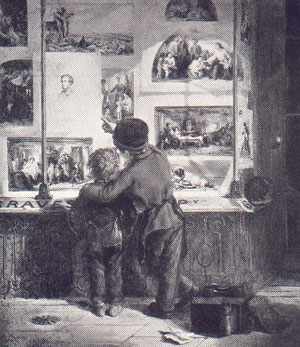 Ultimately, the magic of
Connoisseurship is the ability to see the ‘hand of the artist’ in
that which has not been historically recognized as a work by the artist in
question. In recent history Bernard Berenson (1865-1959) was the champion of
this sort of discovery, and although his reputation has been maligned in recent
years by association with the commercial endeavors of the late Lord Joseph
Duveen (1869-1939), to most art lovers, he is still seen as one of the top
Connoisseurs of the century. Perhaps his perceived weakness was the lack of
direct involvement in the production of art itself, but in fact, he was quite
capable of painting a picture rhetorically, and particularly, over those
paintings which his heart grew attached.
William McDuff: Lost and Found
Ultimately, the magic of
Connoisseurship is the ability to see the ‘hand of the artist’ in
that which has not been historically recognized as a work by the artist in
question. In recent history Bernard Berenson (1865-1959) was the champion of
this sort of discovery, and although his reputation has been maligned in recent
years by association with the commercial endeavors of the late Lord Joseph
Duveen (1869-1939), to most art lovers, he is still seen as one of the top
Connoisseurs of the century. Perhaps his perceived weakness was the lack of
direct involvement in the production of art itself, but in fact, he was quite
capable of painting a picture rhetorically, and particularly, over those
paintings which his heart grew attached.
William McDuff: Lost and Found
Art World’s Dirty Little Secret r malcolm setters / graham setters “The online auction sites were consistently searched for the biography about James Orrock, but it had not turned up. It was time to do a general search and try and find it retail. Surprisingly, rather than being similar to a pocketbook as suspected, it turned out to be a substantial double volume set. When it arrived from England it proved a further surprised - the two books somewhat dwarfed Butlin and Joll’s two-volume set. The biography had artistic bindings with a neoclassical gilt-embossed design. It had been limited to an edition of only 500 copies, with the deluxe edition having a full morocco binding. A rare find indeed! (republished 1976 New York Barron’s Woodbury, 500 copies) On savouring a cursory review of the text and images, the question was wistfully posed as to whether there might be a reference to either Shipwreck, the Rescue or the Orrock Ehrenbrietstein oil paintings. Strangely, the possibility had not been considered, believing in the beginning that the publication would turn out to be minor and only useful as a textual reference on Orrock as a collector. Between pages 74 and 75, a quarter-way through the first volume, a painting called The Wreck was pictured. Stunning! Was it just another familiar image? No! It was the familiar image’ “manna from Heaven! It was a striking full-page photogravure of Shipwreck, the Rescue!
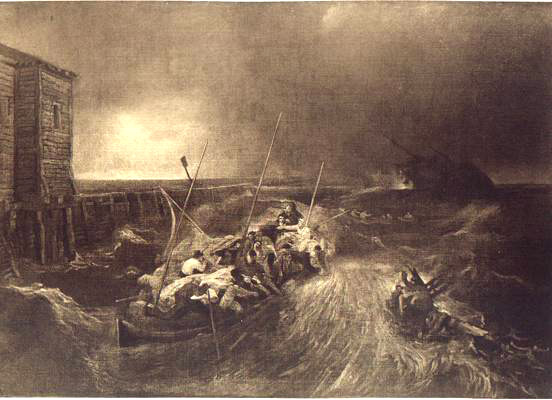
The Wreck Photogravure by Walker E. Cockerell after Shipwreck, the Rescue by J.M.W. Turner RA Photogravures were reproduced from negatives taken direct from the original artwork and show the very touch of the artist’s brush. Due to the size and content, the 1903 Orrock set of books was likely the premier publication of the day, covering a vast range of what was happening in the British art-world at the time. It was produced before the 1904 Christie’s sale when Shipwreck, the Rescue sold at the “highly important” Orrock sale. Because of the close dealings that Orrock had with Agnew’s; and the two former Surveyors of the Queen’s Pictures: Leitch, and Robinson, it was clear there was no argument amongst the cognoscenti at the time over authenticity. As mentioned previously, one of the Surveyors was the previous owner of Shipwreck, the Rescue, and lived until 1913. We were eventually able to secure two more sets of this mammoth publication, one from New York; and a deluxe version, #10, in full guilt-embossed morocco bindings from Amsterdam. Auspiciously, the set from New York was previously owned by the House of Knoedler; at the time of publication they were venerable international art dealers of the highest order. “The writer of Mr. James Orrock, R.I., in Bedford Square, one of the World’s Celebrities at Home series” discussed that he entertained, “visitors as diverse as the Empress Frederick of Germany and Ruskin.” Ruskin of course knew Orrock well; he was “a frequent visitor” to Orrock’s home at 48 Bedford Square, and would have had ample opportunity to study Shipwreck, the Rescue while visiting. Kenneth Clark indicates the significance of this when he writes, “Ruskin, knew Turner personally and understood his work far better than any of us.” [i] Cosmo Monkhouse also visited Mr. Orrock’s collection and wrote rave reviews using expressions such as, “domestic palace of Art."[ii]](#_edn2) As most Turner scholars know, Monkhouse was a premier Turner biographer. The descriptive text in the highly sought after Turner Gallery two-volume publication was “written by W. Cosmo Monkhouse, (1840-1901), art historian and poet, who was an authority on Turner’s art.” It was assumed that an image of Shipwreck, the Rescue had never been published; after the Christie’s sale in 1904 the painting had apparently disappeared abroad with Edwards of Geneva, not to be seen back in England until it returned unrecognized. A hundred years ago few paintings were reproduced, so it was certainly a surprise to discover a print of Shipwreck, the Rescue, the subject of Turner’s Rescue. In modern-times the wide distribution of an image is as easy as taking a photograph: not so in Orrock’s day! On closing the book temporarily, it was time to toast James Orrock R.I., Painter, Connoisseur and Collector, in two volumes ’ " Cheers!
 It is not far fetched that one makes the comparison
between the
Butlin and Joll catalogue and the Orrock books; they are both meant
to serve the same purpose’ “illustrate and endorse British art, and at the same
time broadcast the expertise/connoisseurship of those involved. A large section
in the Orrock set deals with Turner, the artist is described as the first
of four pillars of British art. The text is also presented as a late 19th
century Connoisseur
might be inspired to do. In addition to covering a broad spectrum of British art
and furniture, there is a cross-cultural smattering of oriental ceramics and
other art treasures. Information about the art-world at the time was
understandably integrated with higher philosophic ideals and was presented as an
integral part of the living experience. When poetry was introduced, it was done
as part of the running document.
Effective for its purpose and in keeping with modern isolationist theory that
promotes the narrow focus of cataloguing, the BJ catalogue presents us with a
more legislative vision. The wisdom of a different era is sensed with the 1903
publication: whereas; the BJ catalogue is meant to categorize, provide
conservative information and possibly even limit. The Orrock publication
imparts a broad appreciation of the times, of and for both artist and collector.
The running discourse educates in a subliminal way as one might learn ones own
native tongue.
If one were asked to choose between the two sets - as to which is the
quintessential British art publication of the twentieth century; the award
winning BJ catalogue, or Webber’s, James Orrock R.I., it would be a
difficult pick because of the near full-century generational-gap. Of course the
next generation of Turner “scholarship” will inevitably include more science.
Connoisseurship is a thread
that ties much of this Rescuing Turner story together, but there is
a proviso’ “one must beware of the, ‘’’: magic eye’. It certainly serves its master
well if left to its own volition, but if there is a political fog in the air;
one might just as well be blind. “Lawrence Gowing, Martin’s admired predecessor
at the Tate implored,, ‘’’: when a letter from your girlfriend is dropped through the
door, you don’t have to open it and read the name to know who it’s from.” Ah,
but even letters can be dismissed if the political will warrants it!
As for Martin Butlin, in lieu of any concrete argument against Shipwreck,
the Rescue, he was forced to claim the preeminence of his own
connoisseurship, and that
this should be good enough. But something that nobody knew during the
investigation and curatorial discussions over Shipwreck, the Rescue - the
previous owner James Orrock R.I., R.O.I. was likely the most revered
Connoisseur of the 19th
century. This was at a time when the nomenclature was widely used and an
artistic eye was the only defining element of expertise.
An example of his eminent position within the art community is exemplified
by the relationship he had to one of the most important private art collectors
of his day–Lord Leverhulme. To quote from the
Lady Lever Art Gallery/port
sunlight website: “Leverhulme acquired many of the pieces in the
gallery through the bulk purchase of others’ collections. One of those who was most
influential over his buying tastes was James Orrock, a passionate advocate of
British art. Lever bought Orrock’s own collection in its entirety three times,
in 1904, 1910 and 1912… The major influence
on Lever’s career as a collector was James Orrock.”
From Orrock’s biography, several of his published essays attest to the gentle
articulation that late 19th century prose could impart:
“Turner courted Nature in her poetic and artistic moods, and left her in her
ordinary aspects to be wooed by ordinary minds. His gamut was great indeed. He
could, ‘’’: lay on’ with untiring force from the beginning to the end of a colossal
oil-picture, and, possessed by a more delicate spirit of inspiration, could be
dainty and joyful over a tiny, ‘’’: Berwick,’ a, ‘’’: Loch Katrine,’ or a, ‘’’: Skiddaw.’ His
masculine oil-work, such as, ‘’’: The Shipwreck’ or, ‘’’: Calais Pier,’ stands forth like
a giant on guard over such tender and gem-like drawings as those just named.
Nothing was too mighty for him, nothing too delicate ’ "
James Orrock R.I., R.O.I.”[iii]
It is not far fetched that one makes the comparison
between the
Butlin and Joll catalogue and the Orrock books; they are both meant
to serve the same purpose’ “illustrate and endorse British art, and at the same
time broadcast the expertise/connoisseurship of those involved. A large section
in the Orrock set deals with Turner, the artist is described as the first
of four pillars of British art. The text is also presented as a late 19th
century Connoisseur
might be inspired to do. In addition to covering a broad spectrum of British art
and furniture, there is a cross-cultural smattering of oriental ceramics and
other art treasures. Information about the art-world at the time was
understandably integrated with higher philosophic ideals and was presented as an
integral part of the living experience. When poetry was introduced, it was done
as part of the running document.
Effective for its purpose and in keeping with modern isolationist theory that
promotes the narrow focus of cataloguing, the BJ catalogue presents us with a
more legislative vision. The wisdom of a different era is sensed with the 1903
publication: whereas; the BJ catalogue is meant to categorize, provide
conservative information and possibly even limit. The Orrock publication
imparts a broad appreciation of the times, of and for both artist and collector.
The running discourse educates in a subliminal way as one might learn ones own
native tongue.
If one were asked to choose between the two sets - as to which is the
quintessential British art publication of the twentieth century; the award
winning BJ catalogue, or Webber’s, James Orrock R.I., it would be a
difficult pick because of the near full-century generational-gap. Of course the
next generation of Turner “scholarship” will inevitably include more science.
Connoisseurship is a thread
that ties much of this Rescuing Turner story together, but there is
a proviso’ “one must beware of the, ‘’’: magic eye’. It certainly serves its master
well if left to its own volition, but if there is a political fog in the air;
one might just as well be blind. “Lawrence Gowing, Martin’s admired predecessor
at the Tate implored,, ‘’’: when a letter from your girlfriend is dropped through the
door, you don’t have to open it and read the name to know who it’s from.” Ah,
but even letters can be dismissed if the political will warrants it!
As for Martin Butlin, in lieu of any concrete argument against Shipwreck,
the Rescue, he was forced to claim the preeminence of his own
connoisseurship, and that
this should be good enough. But something that nobody knew during the
investigation and curatorial discussions over Shipwreck, the Rescue - the
previous owner James Orrock R.I., R.O.I. was likely the most revered
Connoisseur of the 19th
century. This was at a time when the nomenclature was widely used and an
artistic eye was the only defining element of expertise.
An example of his eminent position within the art community is exemplified
by the relationship he had to one of the most important private art collectors
of his day–Lord Leverhulme. To quote from the
Lady Lever Art Gallery/port
sunlight website: “Leverhulme acquired many of the pieces in the
gallery through the bulk purchase of others’ collections. One of those who was most
influential over his buying tastes was James Orrock, a passionate advocate of
British art. Lever bought Orrock’s own collection in its entirety three times,
in 1904, 1910 and 1912… The major influence
on Lever’s career as a collector was James Orrock.”
From Orrock’s biography, several of his published essays attest to the gentle
articulation that late 19th century prose could impart:
“Turner courted Nature in her poetic and artistic moods, and left her in her
ordinary aspects to be wooed by ordinary minds. His gamut was great indeed. He
could, ‘’’: lay on’ with untiring force from the beginning to the end of a colossal
oil-picture, and, possessed by a more delicate spirit of inspiration, could be
dainty and joyful over a tiny, ‘’’: Berwick,’ a, ‘’’: Loch Katrine,’ or a, ‘’’: Skiddaw.’ His
masculine oil-work, such as, ‘’’: The Shipwreck’ or, ‘’’: Calais Pier,’ stands forth like
a giant on guard over such tender and gem-like drawings as those just named.
Nothing was too mighty for him, nothing too delicate ’ "
James Orrock R.I., R.O.I.”[iii]
Home
Art World’s Dirty Little Secret Portrait of a Hero
The Unknown Turner Orrock Provenance BJ Catalogue Christie’s [i] Kenneth Clark, The Romantic Rebellion: Romantic versus Classic Art, (Longman Canada Limited, 1973), [ii] Byron Webber, James Orrock R.I., Painter, Connoisseur, Collector; (Chatto & Windus, London, in two volumes 1903), Vol. 2, 226. [iii] Ibid. 1, 61.