Art and Science: Turner's Painting Techniques at the Tate Gallery
image of Shipwreck the Rescue Ian Warrell, Tate Gallery, Joyce Townsend, Turner’s Painting Techniques, Tate Gallery Publications / scientific expertise and expert techniques in authentication / Marilyn Laver, Canadian Conservation Institute (CCI) / expert opinion, criticism, Turner studies art/science at the Tate… Ian Warrell opinion, Andrew Wilton
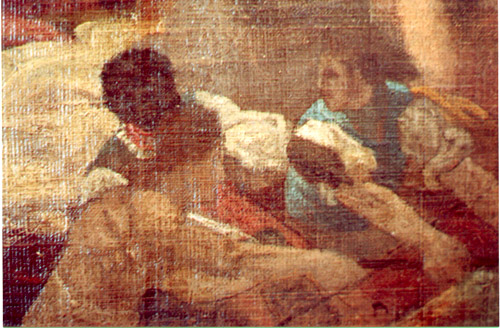
Shipwreck, the Rescue,
a detail showing the auspicious black man
Art World’s Dirty Little Secret
“The effect
that
scientific and technological advance had on the world and society around him,
never really deserted Turner.”[i]
“He was a zealous and intelligent student of the movement towards exact
knowledge which was afoot, and he dabbled respectably in many sciences."(Bayes,1931) Ironically,
in the present era there is apparent fear of an integration between art and science. Why! For many, the following might scramble ideas
of what it means to be either a scientist or a curator.
Is scientific investigation
of artwork the leading edge for art authentication, or merely a cause for
controversy? Could the following 1887 diatribe by nineteenth century
Turner expert, James Orrock, be the first challenge by
connoisseurship
against science invading the purview of the art establishment?

James Orrock R.I., a photogravure print of the former owner of Shipwreck, the Rescue “It cannot be too strongly maintained that the chemist, in his analysis and experiments with pigments, made with the view to prove their fixed or fugitive character under exposure to daylight or sunlight, or where subjected to the pernicious influence of a variously-vitiated town atmosphere, has never so much as touched the practice of the water-colour painter and its results, and it is confidently submitted by Mr. Orrock that the chemist never can. What has the exposure under known test conditions of a simple colour to do with the exposure of infinite mixtures and manipulations of semi-tones and infinities of compound colours, which express the genius of the magician of the Art, as Turner expressed it in one of his wondrous aerial and brilliant Landscapes?” [ii] Although, at the time, this argument against science was won by force of rhetoric and weight of authority; the fugitive nature of watercolour, which both Orrock and Ruskin tried to deny was eventually accepted unequivocally. Rhetoreticians and established authority are still the winners of most modern debate over similar issues, and again; such battles are waged too often in support of interests beyond those of the artwork. In the case with Orrock, both he and Ruskin feared the reaction of potential patrons against watercolour in favour of works done with more stable materials such as oil on canvas. Both Ruskin and Orrock were predominantly watercolourists at the time. There was an interesting contest at a 2002 International Foundation for Art Research (IFAR) conference. A query was lobbed at one of the team who had just completed the catalogue raisonn (c) on Georgia O’Keeffe. The banter took place during the question and answer period after the cataloguers made their presentation. The IFAR journal recorded it as follows: Question: In addition to your examination of all the sheets of paper, did you do technical analysis of the media, for example the pigments? Answer: We didn’t. It wasn’t practical to do it. The problem with any kind of analysis such as you describe is that it relies very much on the scientists doing it. Technical analysis is not magically correct because it’s done with a machine. And so the scientist who does the work has a lot of subjective control over what he or she finds. As ‘scientific’ is the least subjective of any method of analysis, it is possible that the point the cataloguer followed her statement with had more bearing on the matter: “Yes, but it is incredibly time consuming.” [iii]
 This is one of two very extensive studies done by Peter
Bower (Tate Gallery Publications 1990).
In the world of art, scientific
solutions are not always as clear-cut as one would expect. Nonetheless,
Marilyn Laver, P. Eng, our champion in this realm was to try her best to
analyze Shipwreck, the Rescue, and put science to the test. Much to my relief, she was
able to gather all the available records from her previous analysis of the
painting done for RCMP and Interpol in 1982. It
took several months to draw together the results and provide a synopsis, but
unfortunately the package I had been waiting for with such anticipation:
neither proved, nor disproved the painting’s authorship. The irony of scientific
study, although seeking to be absolutely conclusive in its findings can do
little to prove art authorship conclusively. It is more effectively
exploited by law enforcement to prove fraud than by curators, art historians, and
collectors to prove if an object is genuine.
Exculpation, or the elimination
process on which much scientific analysis is based makes it especially good for
providing forensic evidence to disprove authorship, but although it can give as
much support as any system in proving authenticity, only occasionally can it
give absolute guarantees about who painted a picture. From paint samples for
example, “pigment identification can deny but rarely confirm a paintings age.”[iv]
If any miniscule bit of data
places a painting out of context (as the agents in the
Visnei case
were expecting would happen) the entire artwork can be rejected. If pigments,
canvas, paper, wooden supports, or working techniques were not used prior to a
certain date; then a painting purporting to precede that date would
automatically be condemned. On the other hand if innumerable similarities are
found that connect favorably to an artist: art materials, subject matter,
composition, format, brush techniques, palette of colours, and so forth;
but only a sliver of this information is atypical, what then? What if the
preeminent authority on a particular artist disregards the whole raft of
information gathered because of the errant, albeit, inconclusive bit of data and
takes a position more favourable to their own agenda? This does happen, and when
it does, one can only speculate whether the reason goes beyond integrity. There
can certainly be solid reasons for dismissal, such as those relating to overall
, ‘’’: style’, but there are also many rejections that are in large-part ungrounded
and illogical.
This is one of two very extensive studies done by Peter
Bower (Tate Gallery Publications 1990).
In the world of art, scientific
solutions are not always as clear-cut as one would expect. Nonetheless,
Marilyn Laver, P. Eng, our champion in this realm was to try her best to
analyze Shipwreck, the Rescue, and put science to the test. Much to my relief, she was
able to gather all the available records from her previous analysis of the
painting done for RCMP and Interpol in 1982. It
took several months to draw together the results and provide a synopsis, but
unfortunately the package I had been waiting for with such anticipation:
neither proved, nor disproved the painting’s authorship. The irony of scientific
study, although seeking to be absolutely conclusive in its findings can do
little to prove art authorship conclusively. It is more effectively
exploited by law enforcement to prove fraud than by curators, art historians, and
collectors to prove if an object is genuine.
Exculpation, or the elimination
process on which much scientific analysis is based makes it especially good for
providing forensic evidence to disprove authorship, but although it can give as
much support as any system in proving authenticity, only occasionally can it
give absolute guarantees about who painted a picture. From paint samples for
example, “pigment identification can deny but rarely confirm a paintings age.”[iv]
If any miniscule bit of data
places a painting out of context (as the agents in the
Visnei case
were expecting would happen) the entire artwork can be rejected. If pigments,
canvas, paper, wooden supports, or working techniques were not used prior to a
certain date; then a painting purporting to precede that date would
automatically be condemned. On the other hand if innumerable similarities are
found that connect favorably to an artist: art materials, subject matter,
composition, format, brush techniques, palette of colours, and so forth;
but only a sliver of this information is atypical, what then? What if the
preeminent authority on a particular artist disregards the whole raft of
information gathered because of the errant, albeit, inconclusive bit of data and
takes a position more favourable to their own agenda? This does happen, and when
it does, one can only speculate whether the reason goes beyond integrity. There
can certainly be solid reasons for dismissal, such as those relating to overall
, ‘’’: style’, but there are also many rejections that are in large-part ungrounded
and illogical.
|
“It seems to me…that most of our art historians are entirely untrained
in historical method; hence have no objective check upon their subjective,
stylistic intuitions.” -Frank Jewett Mather, Jr., 1938

“The join in the canvas is not typical; as Turner could evidently obtain coarse hessian supports as wide as he required them. I know of only one, which has a joined canvas, and it is larger than this one; The Garden of the Hesperides at the Tate Gallery with a horizontal join almost in the centre…” The Tate Gallery painting to which she was referring is in fact smaller, not larger than Shipwreck, the Rescue, but only marginally, 155.3 x 218.4 cm. versus 161 x 221.5 cm. The unusual technique of joining canvas fragments in order to make one large canvas would appear to support a common authorship rather than the contrary. According to pigment analysis this was done early on, at a time when the artist was being most frugal with his materials. This joining technique and the shortage of canvas of adequate dimension was mentioned in one of Townsend’s own early publications, “Turner’s largest compositions could not be accommodated on artist’s quality canvas, and he sometimes resorted to coarsely woven sacking-type material of the requisite size. On one occasion only, two canvases were joined, and he then painted over the horizontal seam in the middle, for, ‘’’: The Goddess of Discord.’”[xi] If it were not Joseph and his economy-conscious father joining those canvas scraps together to make an adequate painting surface during those oft-mentioned, ‘’’: mean years’’ " who would it have been? Townsend’s disparagement over Turner joining canvases based on the contention that he had access to large enough material must be considered a mute point; everyone else had the same access to the same-size material at the time. Frugality - the desire to be economical is the critical point here! As owner of another somewhat ragged Turner painting, James Orrock (also, the previous owner of Shipwreck, the Rescue), noted: “This picture, curiously enough, was painted over an old portrait’ Mr. Ruskin told me, when I described the case to him, that Turner was so prudent, not to say parsimonious, that he often purchased old pictures cheap for the sake of the canvas and stretcher.”[xii] The father-son team, especially in the early years when Shipwreck, the Rescue would have been painted, often used unorthodox painting supports that emphasized this parsimony: cupboard doors, scraps of wrapping paper, book-boards, common lumber, and even coach panels at one point. Turner himself said that, “Dad never praised me for anything but saving a halfpenny.”[xiii] One can only imagine that whatever remnant was left as the artist’s roll of canvas came to an end, was at times spliced to another roll end’ “Voila, another , ‘’’: sea-piece’ or other larger-scale production. If done once, could it not be done twice, or even three times. Knowing that Turner actually spliced canvases in this way surely ought to be viewed in a positive way. In Seeing Through Paintings, a comprehensive technical overview about the physical state of pictures, Turner is specially highlighted for his “expedient choice of supports.” “Joyce Townsend notes that Turner (1775-1851) used not only makeshift canvases but also panels ‘strongly suggestive of cupboard doors.’”[xiv] It is also logical to accept that whoever the artist was that joined these large pieces of canvas together was likely engrossed with a monumental series of pictures (as Turner was at the time). Otherwise the roll-ends might have been used for smaller productions. And according to the business address given to the Royal Academy at this time, it appears that Turner had set up a new work space at 75 Norton Street, Portland Road. His submissions to the R.A. for the next four-year period were credited to this address in any case. Might this suggest that Turner’s new space was being used largely for that monumental series of sea disasters that would carry his fame for the ensuing several decades?[3] Another contentious point in Townsend’s 1997 reply dealt with the ground-layer/primer. Shipwreck, the Rescue had been painted on a, ‘’’: brown ground’ according to the CCI tests.[4] Townsend wrote, “I have never seen a brown ground, only red ones, in early Turners’ " Quoting Rothenstein and Butlin’s publication: Turner “continued to use the relatively subdued colouring of Wilson and Titian, though in a more naturalistic form’ painted over a pale brown ground.”[xvi] It seems conclusive that brown grounds were used. Included in the same statement by those two Turner experts is the proviso that for water and sky Turner was starting to use white grounds early in the century.

Electron-microscopic cross-section of paint layer, SW the Rescue
After criticism
from colleagues and potential patrons over the darkness of
some of his very early work it is understandable that Turner would succumb to public
pressure and start using the white ground. Turner was certainly sensitive to such criticism. “Of
Turner’s sensitiveness to criticism, Mr. Ruskin says’ , ‘’’: To censure, Turner was
acutely sensitive; owing to his own natural kindness, he felt it for himself or
for others, not as criticism, but as cruelty. He knew that however little his
higher power could be seen, he had done at least as much as ought to save him
from wanton insult.’”[xvii]
We are given a somewhat confident dating for this tonal transition by Silvia Ginzburg,
“Beginning in 1806-07, in fact, Turner embarked on a new direction in his
research of color, experimenting in his oil paintings with the use of a white
background for the sky and water areas, so as to provide a greater luminosity
and brightness to the light tones, basing himself on the results he had already
obtained in his watercolors by leaving certain areas of the white paper
unpainted’ He used the white background for the first time in his preliminary oil
sketches of Thames, in 1806-07.”[xviii]
More recent evidence indicates that this date is too late.
Shipwreck, the Rescue is one painting that would surely have been
criticized for its darkness, and thus, would have been pivotal in his stylistic
development! Because of its
early date (most probably the earliest of the shipwreck series) it might
have also been one of a rare-few large sea-pieces painted predominantly on a
rich brown ground. As one learns to appreciate Turner’s work further, it becomes
evident that other stylistic certainties support that Shipwreck, the Rescue was
painted early, even before Shipwreck c1805, which was painted on an
ostensibly white ground (according to Townsend).
The
third contentious point in Joyce Townsend’s 1997 letter: “the hessian
supports only have 2-3 threads per centimeter: the canvas in question [Shipwreck,
the Rescue] is very fine by the standards of Turner.” Here the discussion
relates to the canvas support and the number of threads counted per linear
centimeter. It was stated in Marilyn Laver’s report that Shipwreck, the
Rescue has 13x12 threads per centimeter: “The original canvas of the
painting was roughly spun (approximately 13 x 12 threads per centimeter) and has
been joined horizontally across the middle.”[5]
Quoting this time from a 1992 paper Townsend published in the IIC, a
conservation sciences journal: “The canvases Turner used in earlier years,
particularly the very large ones, were coarse, with rather few threads per
centimeter: sometimes as few as three to four but more often 10-12. By
the late 1820’s he was using finer canvases, with 14-18 threads per centimeter.”[xix]
This appears to contradict Townsend’s statement in her letter to Laver. After
personally seeing the painting in 2001, Martin Butlin by way of casual
observation conceded that Shipwreck, the Rescue was painted on the same
type of canvas as the other paintings from Turner’s early sea-piece series.
In
defense of Townsend over the
inconsistencies in her letter: all the data that can be accumulated and
tabulated about even one artist, makes it nearly impossible to faultlessly
remember every detail. I suspect that these apparent inaccuracies came after a
quick review of her previous findings and should be considered a minor oversight
or misinterpretation, but unfortunately such error can unfairly drive a
coffin-nail into a subject painting.
If we deny the hint of willful subterfuge, one can only
wonder why such a reply? It is not as if the inquiry originated
from Joe Public, Marilyn Laver was a highly trained professional deserving
due regard.
Nevertheless, if there is no consistent or accurate application of the
scientific community’s own labour, the system of art authentication must again
fall back completely to the vagaries of art connoisseurship (with a small ‘c’),
and its attendant politics. It is clear that the above string of inconsistencies
derides the usefulness of accumulating data. Unfortunately, in turn, if some of
the curatorial responses and opinions received about Shipwreck, the
Rescue over the years are any indication as to the efficacy of the more
visceral approach, we can only wring our hands in despair.
Dating back to 1982 when the police had the painting held-up for testing,
Marilyn requested comparative information from England in order to help
determine how the painting compared to other paintings by Turner. The
reply received from the Principal Scientific Officer of The National
Gallery,
Joyce Plesters makes an amusing interlude so I have quoted it
entirely:
Dear Ms. Laver,
Thank you for your letter of
the 23 July. I am sorry to say that I am really quite unable to help you, as I
have never done much work with English school paintings. We have only a very
small representative collection of them here, the principal collection being at
the Tate Gallery, which is the National Gallery of British and modern foreign
art. They do not have a research laboratory, though occasionally we try and
solve the occasional specific problem connected with treatment by examining
samples from their pictures. Nothing much in the way of Turner (other than
watercolours) or Gainsborough has reached us. I have always been a little puzzled by the
results of analysis of the late Turner paint boxes, as published by Hanson.
Someone has remarked scathingly that perhaps much of what was left in the box
was what he didn’t use, rather than what he did. The lake pigments were
also rather strange with all the unusual substrates. Thinking of your own
results for identification of pigments in the “Turner” painting under
consideration, although some of his oil paintings, for example the early
Venetian scenes, are quite colourful with a palette which includes brilliant
greens and violet-pinks, in many of his paintings the colours do seem to be
restricted to blues and orange-brown tones.
If you haven’t already written to the
Tate Gallery they might be able to help you with the matter of the types of
canvas and ground used by Turner, since observations of these might have been
made in coarse of treatment of the paintings. They might also be able to help
with your Gainsborough[6]
questions since some treatment and examination would have been done
preparatory to the large Gainsborough exhibition held at the Tate Gallery
comparatively recently. Write to Viscount Dunlace, Chief Restorer at the Tate
Gallery. Someone else who might advise you on Gainsborough is Dr. John Hayes,
Director, National Portrait Gallery, London WC2. He is a specialist on the
artist and wrote the catalogue for the recent exhibition.”
Marilyn Laver’s other request in 1982 went to Martin Butlin who apparently
passed it along to his friend, the same Viscount mentioned by Plesters. He was
the, ‘’’: Keeper of Conservation’ at the Tate Gallery.[7]
The letter received from him in August 1982 was even more bewildering:
“I can confirm what you have already found out
that there is very little published on studies of Turner’s technique or the
analysis of the media and pigments which is, in part, our fault as there are a
fair accumulation of technical reports and observations in our technical record
files which have never been correlated or taken a stage further.’, ‘’’: As to your
questions, (a) I would have thought it rather unusual for Turner to use such a
limited palette, and (b) he usually worked on a white ground following his
training as a watercolourist ’ " though this was not always the case. The coarse
canvas weave also is unusual apart from some works painted in Italy’ The canvas
size also does not correspond to any of Turner’s normal formats though it could
be cut down.”
The Viscount’s first point might be dealt with succinctly using the words of Turner’s noted
antagonist, Sir George Beaumont, who had in 1802 clearly used the limited
palette issue against Turner’s early work when he mocked, “borrowed from Claude,
but all the colouring forgotten.”[xx]
Philip Hamerton was more kind when he called Turner’s very early paintings,
“wanting in the charms of light and colour.”[xxi]
Later he gave the source of such perceived inadequacy: “The most famous of
the early pictures, those solid, substantial pictures which are so strikingly
unlike the manner of his full maturity, were painted simply on Dutch principles
of gray and brown, with a patch of red here and there, to make people believe it
was colour.”[xxii]
From Turner’s own 1802 notebook connected to his visit to the Louvre he confirms
his adamant belief that, “Nature rather demanded less of colour.”[xxiii]
Thornbury
quotes Ruskin, twice, over the limited colour to be found in Turner’s
early oils, “The, ‘’’: Crossing the Brook,’ and such other elaborate and large
compositions, are actually painted in nothing but grey, brown, and blue with a
point or two of severe local colour in the figures’ (Ruskin could have been
looking directly at Shipwreck, the Rescue when he made this statement) In
his first period, the pictures are notable for a grey and brown colour,
and for a sometimes heavy touch. Turner is more anxious for form than colour;
the colours are simple and few.”[xxiv]
Not all was gloom with Turner’s “black old” oil pictures painted after moving to
his Harley Street studio in 1802. According to W.C. Monkhouse and W.L. Wyllie,
A.R.A, the mystery of even Turner’s early dark-work was incomparable’ “Wyllie
pronounced: “When we are back among the conventional black old pictures, such as
The Shipwreck; The Spithead; or even the impossible, gloomy,
Garden of the Hesperides; we feel that, after all, the old Wizard was a
worker of wonders, and that he, in his dark London room, with little more than
black, brown, and gray, could move us to awe, terror, or wonder by the
thousand-and-one secrets which he had at his finger’s ends.”[xxv]
Jack Lindsey, one of Turner’s later biographers flatly contradicts the second
point the Viscount made about the white ground colour: “approximately 1798,
Turner reverses his technique used for watercolors when experimenting with
oils. Instead of the traditional white ground he used in watercolors, Turner
worked from a dark ground in order to achieve a stronger range of tones”[xxvi]
The
Viscount’s point
about the thread-count, “the coarse canvas weave,” was
completely contrary but equally as irresolute as the information received back from
Joyce Townsend at the Tate 15 years later. Townsend wrote that the weave was
“very fine by the standards of Turner.” Alas, Dunlace’s final claim about
overall size was also wrong. There are indeed several of Turner’s early
sea-pieces that are close in size. Particularly, The, ‘’’: Bridgewater
Seapiece, exh. 1801, and Shipwreck,
the Rescue are both large, and except for a porcine whisker, they are the
same size; they are of irregular un-standard dimensions as well. If the
original stretchers or strainers were not made for the same artist at roughly
the same time this comparison must be considered a miracle of coincidence. By
default the Viscount was at least right about one thing’ “similarity of size is
relevant. For example: when comparing the small oil on panel Limekiln at
Coalbrookdale with its potential mate, Butlin and Joll deemed comparative
sizes a pertinent issue. They wrote that “both panels, incidentally, are of almost identical size.”[xxvii]
If comparative size is important with a little picture, it is certainly even
more so with a very large one, if for no other reason that there are so many
more small and medium sized ones. What are the numerical odds of two, ‘’’: odd sized’
custom stretched canvases measuring over seven feet in width and over five feet
high, having near identical dimensions!
I have always been a little puzzled by the
results of analysis of the late Turner paint boxes, as published by Hanson.
Someone has remarked scathingly that perhaps much of what was left in the box
was what he didn’t use, rather than what he did. The lake pigments were
also rather strange with all the unusual substrates. Thinking of your own
results for identification of pigments in the “Turner” painting under
consideration, although some of his oil paintings, for example the early
Venetian scenes, are quite colourful with a palette which includes brilliant
greens and violet-pinks, in many of his paintings the colours do seem to be
restricted to blues and orange-brown tones.
If you haven’t already written to the
Tate Gallery they might be able to help you with the matter of the types of
canvas and ground used by Turner, since observations of these might have been
made in coarse of treatment of the paintings. They might also be able to help
with your Gainsborough[6]
questions since some treatment and examination would have been done
preparatory to the large Gainsborough exhibition held at the Tate Gallery
comparatively recently. Write to Viscount Dunlace, Chief Restorer at the Tate
Gallery. Someone else who might advise you on Gainsborough is Dr. John Hayes,
Director, National Portrait Gallery, London WC2. He is a specialist on the
artist and wrote the catalogue for the recent exhibition.”
Marilyn Laver’s other request in 1982 went to Martin Butlin who apparently
passed it along to his friend, the same Viscount mentioned by Plesters. He was
the, ‘’’: Keeper of Conservation’ at the Tate Gallery.[7]
The letter received from him in August 1982 was even more bewildering:
“I can confirm what you have already found out
that there is very little published on studies of Turner’s technique or the
analysis of the media and pigments which is, in part, our fault as there are a
fair accumulation of technical reports and observations in our technical record
files which have never been correlated or taken a stage further.’, ‘’’: As to your
questions, (a) I would have thought it rather unusual for Turner to use such a
limited palette, and (b) he usually worked on a white ground following his
training as a watercolourist ’ " though this was not always the case. The coarse
canvas weave also is unusual apart from some works painted in Italy’ The canvas
size also does not correspond to any of Turner’s normal formats though it could
be cut down.”
The Viscount’s first point might be dealt with succinctly using the words of Turner’s noted
antagonist, Sir George Beaumont, who had in 1802 clearly used the limited
palette issue against Turner’s early work when he mocked, “borrowed from Claude,
but all the colouring forgotten.”[xx]
Philip Hamerton was more kind when he called Turner’s very early paintings,
“wanting in the charms of light and colour.”[xxi]
Later he gave the source of such perceived inadequacy: “The most famous of
the early pictures, those solid, substantial pictures which are so strikingly
unlike the manner of his full maturity, were painted simply on Dutch principles
of gray and brown, with a patch of red here and there, to make people believe it
was colour.”[xxii]
From Turner’s own 1802 notebook connected to his visit to the Louvre he confirms
his adamant belief that, “Nature rather demanded less of colour.”[xxiii]
Thornbury
quotes Ruskin, twice, over the limited colour to be found in Turner’s
early oils, “The, ‘’’: Crossing the Brook,’ and such other elaborate and large
compositions, are actually painted in nothing but grey, brown, and blue with a
point or two of severe local colour in the figures’ (Ruskin could have been
looking directly at Shipwreck, the Rescue when he made this statement) In
his first period, the pictures are notable for a grey and brown colour,
and for a sometimes heavy touch. Turner is more anxious for form than colour;
the colours are simple and few.”[xxiv]
Not all was gloom with Turner’s “black old” oil pictures painted after moving to
his Harley Street studio in 1802. According to W.C. Monkhouse and W.L. Wyllie,
A.R.A, the mystery of even Turner’s early dark-work was incomparable’ “Wyllie
pronounced: “When we are back among the conventional black old pictures, such as
The Shipwreck; The Spithead; or even the impossible, gloomy,
Garden of the Hesperides; we feel that, after all, the old Wizard was a
worker of wonders, and that he, in his dark London room, with little more than
black, brown, and gray, could move us to awe, terror, or wonder by the
thousand-and-one secrets which he had at his finger’s ends.”[xxv]
Jack Lindsey, one of Turner’s later biographers flatly contradicts the second
point the Viscount made about the white ground colour: “approximately 1798,
Turner reverses his technique used for watercolors when experimenting with
oils. Instead of the traditional white ground he used in watercolors, Turner
worked from a dark ground in order to achieve a stronger range of tones”[xxvi]
The
Viscount’s point
about the thread-count, “the coarse canvas weave,” was
completely contrary but equally as irresolute as the information received back from
Joyce Townsend at the Tate 15 years later. Townsend wrote that the weave was
“very fine by the standards of Turner.” Alas, Dunlace’s final claim about
overall size was also wrong. There are indeed several of Turner’s early
sea-pieces that are close in size. Particularly, The, ‘’’: Bridgewater
Seapiece, exh. 1801, and Shipwreck,
the Rescue are both large, and except for a porcine whisker, they are the
same size; they are of irregular un-standard dimensions as well. If the
original stretchers or strainers were not made for the same artist at roughly
the same time this comparison must be considered a miracle of coincidence. By
default the Viscount was at least right about one thing’ “similarity of size is
relevant. For example: when comparing the small oil on panel Limekiln at
Coalbrookdale with its potential mate, Butlin and Joll deemed comparative
sizes a pertinent issue. They wrote that “both panels, incidentally, are of almost identical size.”[xxvii]
If comparative size is important with a little picture, it is certainly even
more so with a very large one, if for no other reason that there are so many
more small and medium sized ones. What are the numerical odds of two, ‘’’: odd sized’
custom stretched canvases measuring over seven feet in width and over five feet
high, having near identical dimensions!
 Bridgewater Sea Piece
exhibited Royal Academy 1801 162.5 x
221 cm.
(seen here)
Shipwreck, the Rescue
c1801/2 161 x 221.5
Half
a century earlier, Kenneth Clark, then Director of the National Gallery in
London had prompted the installation of apparatuses needed for scientific
testing on works of art:
“Thanks to Kenneth Clark’s decision to establish
a modern laboratory with the latest equipment, great strides were being made.
Besides the new X-ray, ultra-violet and infra-red (sic) rays, all of which
provided important clues, colour values could now be measured and the relative
ages of mediums and varnishes tested by means of a polariscope and spectroscope.
Microscopes, photo-microscopes and chemical analyses were being used to detect
the slightest presence of paint in any material that might be removed.”[xxviii]
At about this same time Clark had succumbed to negative pressures against his
attempts at cleaning some of the nation’s old masters. Those parallel scientific
innovations being introduced by Clark must also have been blocked for similar
reasons, and thus, his progressive efforts seemed to evaporate. It is evident
that his challenge to bring Britain forward in this regard was met with
indifference, and possibly even disdain. Could this be recorded as another one of those earlier conflicts between the art
establishment - the specialist with her pretentious eye; looking; looking;
looking; and science - a battle
that seems to rage to the present day.
In all fairness, credit must be given the respondents to Marilyn Laver and the CCI enquiries; they made somewhat of an effort to explain the reason for their
ideas. But what about the subsequent correspondence from the Tate in May 1997? It was from Ian Warrell, Assistant Keeper of the British Collection,
and read as such: “Sadly, though it is a dramatic and well-painted work, I
think it very unlikely that it was executed by J.M.W. Turner. The only part that
comes close to his handling of paint is the use of the highlights on the tops of
the waves, but in all other respects it bears no relation to his work, although
it is clearly an early nineteenth century picture.” Warrell’s lofty breviate to
Marilyn Laver was relayed to me along with her own letter noting that Warrell
based his opinion on only an 8 x 10 photograph.
Bridgewater Sea Piece
exhibited Royal Academy 1801 162.5 x
221 cm.
(seen here)
Shipwreck, the Rescue
c1801/2 161 x 221.5
Half
a century earlier, Kenneth Clark, then Director of the National Gallery in
London had prompted the installation of apparatuses needed for scientific
testing on works of art:
“Thanks to Kenneth Clark’s decision to establish
a modern laboratory with the latest equipment, great strides were being made.
Besides the new X-ray, ultra-violet and infra-red (sic) rays, all of which
provided important clues, colour values could now be measured and the relative
ages of mediums and varnishes tested by means of a polariscope and spectroscope.
Microscopes, photo-microscopes and chemical analyses were being used to detect
the slightest presence of paint in any material that might be removed.”[xxviii]
At about this same time Clark had succumbed to negative pressures against his
attempts at cleaning some of the nation’s old masters. Those parallel scientific
innovations being introduced by Clark must also have been blocked for similar
reasons, and thus, his progressive efforts seemed to evaporate. It is evident
that his challenge to bring Britain forward in this regard was met with
indifference, and possibly even disdain. Could this be recorded as another one of those earlier conflicts between the art
establishment - the specialist with her pretentious eye; looking; looking;
looking; and science - a battle
that seems to rage to the present day.
In all fairness, credit must be given the respondents to Marilyn Laver and the CCI enquiries; they made somewhat of an effort to explain the reason for their
ideas. But what about the subsequent correspondence from the Tate in May 1997? It was from Ian Warrell, Assistant Keeper of the British Collection,
and read as such: “Sadly, though it is a dramatic and well-painted work, I
think it very unlikely that it was executed by J.M.W. Turner. The only part that
comes close to his handling of paint is the use of the highlights on the tops of
the waves, but in all other respects it bears no relation to his work, although
it is clearly an early nineteenth century picture.” Warrell’s lofty breviate to
Marilyn Laver was relayed to me along with her own letter noting that Warrell
based his opinion on only an 8 x 10 photograph.
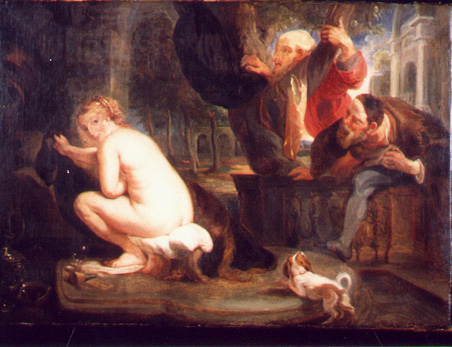 P.P. Rubens, Susanna and the
Elders 1638
It
was soon evident that matters went far beyond the style argument. Martin Butlin, Warrell’s
apparent mentor and former boss at the Tate, in due course made it to
Canada to see Shipwreck, the Rescue in situ. Butlin’s criticisms over the
painting were exactly opposite to those that Warrell had offered, and
particularly with reference to the waves. Martin Butlin
discussed Shipwreck, the Rescue while standing in front of the painting Susanna and the
Elders by P.P. Rubens. The frightful smirk on the face of Susanna said it
all. The false-witness allegory from whence Susanna’s biblical story originated was now playing out with
Shipwreck, the Rescue. Her dilemma was resolved by a separate
examination of the belligerents. The conflicting evidence over her alleged infidelity caused her life to be spared. Nonetheless,
the
dilemma at hand is succinctly addressed later under the heading
Tribal Instincts.
P.P. Rubens, Susanna and the
Elders 1638
It
was soon evident that matters went far beyond the style argument. Martin Butlin, Warrell’s
apparent mentor and former boss at the Tate, in due course made it to
Canada to see Shipwreck, the Rescue in situ. Butlin’s criticisms over the
painting were exactly opposite to those that Warrell had offered, and
particularly with reference to the waves. Martin Butlin
discussed Shipwreck, the Rescue while standing in front of the painting Susanna and the
Elders by P.P. Rubens. The frightful smirk on the face of Susanna said it
all. The false-witness allegory from whence Susanna’s biblical story originated was now playing out with
Shipwreck, the Rescue. Her dilemma was resolved by a separate
examination of the belligerents. The conflicting evidence over her alleged infidelity caused her life to be spared. Nonetheless,
the
dilemma at hand is succinctly addressed later under the heading
Tribal Instincts.
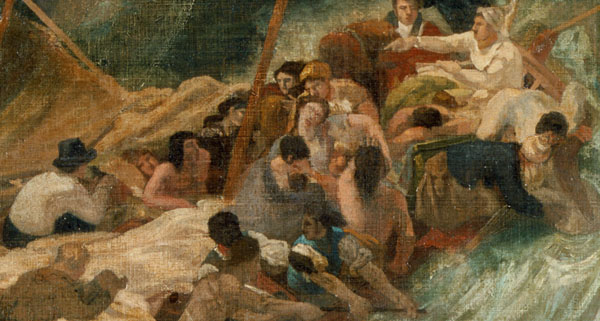 Detail of the Rescue Boat from
Shipwreck, the Rescue
Detail of the Rescue Boat from
Shipwreck, the Rescue
To help understand the relationship of Shipwreck, to Shipwreck, the
Rescue, Silvia Ginzburg borrows from two art-world figures that had great
impact on Turner: “Sir Joshua Reynolds’ points out that invention in art arises
from the new combination of images already present in the memory. Ruskin holds
that Turner never lost the visual impression produced in him by any image: he
had never “shifted the central pilaster of the old image.’”[xxx]
In both works one can see Turner’s early harmonious integration of figures
together and within their setting, and at the same time see that the figures are
largely recognizable. These Turner archetypes were discussed in detail during
Martin Butin’s visit to Canada.

Turner’s Wilson sketchbook seem relevant. The sketchbook is purportedly from c1797 and would thus be central to much of Turner’s early work. It is evident that early on Turner was experimenting with the orientation of boats in order to present the best vantage for composing his human dramas.
Of the three 1997 requests by Laver for curatorial opinion: the one from the Tate was the only derisive critique, the one from Canada was mostly supportive, and the third English expert failed to acknowledge her letters and faxes, even after several attempts. The supportive opinion came from one who is very knowledgeable about Turner’s work; Alan Chong, Curator of European Art, Art Gallery of Ontario (AGO). The following is an excerpt from his letter 29 May 1997: “Many thanks for sending me a photograph of a painting attributed to Turner. The work seems associated with the early work of JMW Turner and could possibly be a preliminary sketch by the artist. The work is certainly old and from the period. It resembles a work in the Tate of similar subject: Butlin and Joll no. 33, of 1798 (Boat in a storm by a pier). Allan Chong also mentions the unusually loose brushwork,[10] and that he took the initiative of requesting, by mail, an opinion from Martin Butlin (apparently there was no reply). Early Turner sea-pieces were disparaged very much for this very reason, the loose brushwork. From detailed research A.J. Finberg recognized that by 1803 Turner " was leading the way in a radical change of technique in landscape painting. In places of the mechanical realization, the equal finishing of all objects included in the picture, which was then demanded of every landscape painter, he was substituting a more subtle and varied treatment, one responsive to shades of feeling and meaning.” (Finberg, 1961, P. 101) From contemporary criticisms by Sir George Beaumont and John Constable, h e also made the astute observation that Turner’s “style differed in two opposite directions from the one then in vogue; it differed not only by a deliberate vagueness or looseness of definition in appropriate places, but also, in other places by an excessive vigour of realization.”
 Infrared photograph:
to assist in the search of under-drawing the pigments
are made to appear somewhat transparent
As
mentioned, the document from Marilyn Laver looked very professional and came
in a tidy three ring binder with a dramatic black and white photograph of
Shipwreck, the Rescue on the cover. There were several large format
photographs: full colour; infrared; ultraviolet; electron-microscopic,
and
detailed images of both the back and front of the painting, There were also
several x-radiographic images. It had page after page of test
results with pigment names broken down into linguistically impossible
contrivances, and photographs that presented the painting in many different
guises. In the introduction, Marilyn Laver described the genesis of her report as follows:
“In 1982, a scientific examination study was
undertaken at the Canadian Conservation Institute (Ottawa) on a painting on
canvas entitled “Shipwreck ’ " The Rescue” in order to determine whether the
materials and technique of the work were consistent with those of J. M. W.
Turner.
The painting was part of a group of works;
which included others in the style of Picasso, Collins and Gainsborough. The
request for the study came from the Royal Canadian Mounted Police (Cpl. B.
Roberts, Vancouver) and Interpol (John Lyons, Ottawa). Time for the
investigation was limited as the information was required for a trial in
Vancouver in 1982. A verbal report was made to Crown Prosecutor Powell, in
Vancouver by Marilyn Laver, however; expert testimony was not required in court.
As the case was settled on the basis of other evidence, further analytical work
was not pursued; no formal report was required and none was written. In 1997…
the current private owner of the painting requested an evaluation of the data
from the earlier study, resulting in this report, prepared in cooperation with CCI.”
The observations
and conclusions
were interspersed with guarded comments trying to explain the inexplicable, but
at the same time relying on the previously discussed 1997 reply from
Townsend:
“The painting shows evidence of age which is
consistent with a work from the period around 1800. It has undergone several
conservation treatments, including retouching and attachment of three lining
canvases.[11]
It bears a varnish layer with the milky fluorescence, which often results from
aging. The use of lead antimonite yellow [Naples yellow] also suggests a 1750
-1850 date-range, the period when the pigment was most popular.
Most of the stylistic features observed suggest
that this is an unfinished work: for example, the lack of detail in many areas
of the composition, and the thinness of the paint with the ground layer and
pentimenti visible.
The materials from this painting, which were
analyzed, were available to J.M.W. Turner in his lifetime. The pigments
identified suggest the more restricted palette characteristic of his early years
(before about 1805), prior to his well-known experimentation with new materials.
Relative to published analyses of Turner works, some of the pigment usage is
uncommon:[12]
ultramarine in a green mixture, lead antimonite yellow (Naples yellow)[13],
and barium sulfate in the ground layer.”
Note: Sir Richard Westmacott, one of the party
about to start for Italy, asked Turner if he could do anything for him,, ‘’’: No,’
said Turner,, ‘’’: unless you will bring me some Naples yellow.’”[xxxiv]
Hamerton also supports Marilyn Laver’s statement about Turner’s experimental nature
and use of new colours as they were made available:
“He used any new colour that the experimentalizing ingenuity of modern chemistry
could invent for the temptation of an artist.”[xxxv]
With respect to Marilyn Laver’s comment over the “unfinished” appearance of
the painting and “lack of detail in many parts of the composition” - this made
sense for a very early Turner painting. It was a frequent complaint lodged by
several contemporary critics and colleagues: “The feature that attracted most
attention from contemporary critics was, however, the absence of complete
realization of the figures and other foreground objects. Nothing it was
complained was ‘made out’, he had no ’execution’, his foregrounds were always
‘unfinished’.” (Finberg 1961, p. 101)
Infrared photograph:
to assist in the search of under-drawing the pigments
are made to appear somewhat transparent
As
mentioned, the document from Marilyn Laver looked very professional and came
in a tidy three ring binder with a dramatic black and white photograph of
Shipwreck, the Rescue on the cover. There were several large format
photographs: full colour; infrared; ultraviolet; electron-microscopic,
and
detailed images of both the back and front of the painting, There were also
several x-radiographic images. It had page after page of test
results with pigment names broken down into linguistically impossible
contrivances, and photographs that presented the painting in many different
guises. In the introduction, Marilyn Laver described the genesis of her report as follows:
“In 1982, a scientific examination study was
undertaken at the Canadian Conservation Institute (Ottawa) on a painting on
canvas entitled “Shipwreck ’ " The Rescue” in order to determine whether the
materials and technique of the work were consistent with those of J. M. W.
Turner.
The painting was part of a group of works;
which included others in the style of Picasso, Collins and Gainsborough. The
request for the study came from the Royal Canadian Mounted Police (Cpl. B.
Roberts, Vancouver) and Interpol (John Lyons, Ottawa). Time for the
investigation was limited as the information was required for a trial in
Vancouver in 1982. A verbal report was made to Crown Prosecutor Powell, in
Vancouver by Marilyn Laver, however; expert testimony was not required in court.
As the case was settled on the basis of other evidence, further analytical work
was not pursued; no formal report was required and none was written. In 1997…
the current private owner of the painting requested an evaluation of the data
from the earlier study, resulting in this report, prepared in cooperation with CCI.”
The observations
and conclusions
were interspersed with guarded comments trying to explain the inexplicable, but
at the same time relying on the previously discussed 1997 reply from
Townsend:
“The painting shows evidence of age which is
consistent with a work from the period around 1800. It has undergone several
conservation treatments, including retouching and attachment of three lining
canvases.[11]
It bears a varnish layer with the milky fluorescence, which often results from
aging. The use of lead antimonite yellow [Naples yellow] also suggests a 1750
-1850 date-range, the period when the pigment was most popular.
Most of the stylistic features observed suggest
that this is an unfinished work: for example, the lack of detail in many areas
of the composition, and the thinness of the paint with the ground layer and
pentimenti visible.
The materials from this painting, which were
analyzed, were available to J.M.W. Turner in his lifetime. The pigments
identified suggest the more restricted palette characteristic of his early years
(before about 1805), prior to his well-known experimentation with new materials.
Relative to published analyses of Turner works, some of the pigment usage is
uncommon:[12]
ultramarine in a green mixture, lead antimonite yellow (Naples yellow)[13],
and barium sulfate in the ground layer.”
Note: Sir Richard Westmacott, one of the party
about to start for Italy, asked Turner if he could do anything for him,, ‘’’: No,’
said Turner,, ‘’’: unless you will bring me some Naples yellow.’”[xxxiv]
Hamerton also supports Marilyn Laver’s statement about Turner’s experimental nature
and use of new colours as they were made available:
“He used any new colour that the experimentalizing ingenuity of modern chemistry
could invent for the temptation of an artist.”[xxxv]
With respect to Marilyn Laver’s comment over the “unfinished” appearance of
the painting and “lack of detail in many parts of the composition” - this made
sense for a very early Turner painting. It was a frequent complaint lodged by
several contemporary critics and colleagues: “The feature that attracted most
attention from contemporary critics was, however, the absence of complete
realization of the figures and other foreground objects. Nothing it was
complained was ‘made out’, he had no ’execution’, his foregrounds were always
‘unfinished’.” (Finberg 1961, p. 101)
“In comparison with well-documented Turner paintings, there are two features of ‘Shipwreck ’ " The Rescue’ which are atypical. First, the join in the canvas of the painting is unusual; only two[14] have been noted by Townsend in her major study of Turner works at the Tate Gallery. Second, none of the works examined by Townsend contain a brown ground layer, and all of the early seascapes are on white grounds.[15] It can be concluded that physical evidence suggests that the painting originates from the time period of J. M. W. Turner and comprises material available to him. Comparison to current data on Turner’s working methods and use of materials shows some differences. The question of attribution to any particular artist should be addressed by a curatorial expert on Turner’s work; based on content and style.” It is apparent that once the police seized the painting there was great care taken to guarantee that the evidence would all be of forensic nature. The shipping case was sealed with multiple stickers, the painting had its own Mountie as escort, and once it arrived in Ottawa much care was taken to secure the results of testing. In Laver’s words, “To preserve the chain of custody of the evidence during the police investigation, the painting was marked (ML) on the back by Laver on entry into the building and all samples were kept in a locked vault or secure laboratory while under analysis.”[xxxvi] The methods of analysis of the painting included both non-destructive and the taking of samples, albeit miniscule samples. Laver explained everything in great detail. She explained the various pieces of sophisticated equipment and chemicals involved in the process. She also gave a detailed list of publications used for comparing data. We might reflect on the purpose of the efforts of any such scientific investigation at this point. It seems apparent that they are truth seeking, and not merely a flatulent attempt to obscure reality. This is left up to those that might contradict the evidence. It must also be accepted, as Plato illumined: firstly; that justice is defined strictly by the powers that be, but gladly, in the second instance; that “unjust man will be a god-forsaken creature.” [xxxvii] Science as it relates to the art world is not at this point the power behind what is defined as right or wrong; it is only the compliant servant. The great Greek philosopher also fortifies the unassailable nature of this sad and somewhat gratuitous state by confirming that “so far as arts are concerned’ no art [or science] ever studies or enjoins the interest of the superior or stronger party, but always that of the weaker over which it has authority.” [xxxviii] Scientific Report continued For the entertaining story that was spawned from the investigation of Shipwreck, the Rescue see…
Art World’s Dirty Little Secret
J.M.W. Turner Style Forensics Connoisseurship
HOME
J.M.W. Turner
Penticton
(c) setters 2003, Rescuing Turner: The Art Project & [/) [3] Jack Lindsay suggests the change of address brought Turner closer to Sarah Dandy, his companion at the time. There would be no need to dispute that the change of location may have served both purposes. [4] Peter Paul Biro (Art Restoration and Forensic Studies in Art) reviewed this finding in his report of Oct. 2000, saying that he believed the ground colour to be lighter in tone than brown. (The primer is usually applied beforehand to give a uniformity of texture, absorbency, and structural stability to the canvas. The ground relates to the overall tonal values of the picture.) [5] Peter Paul Biro (Art Restoration and Forensic Studies in Art) in his report of Oct. 2000 consistently came up with 12 X 12 threads per centimeter. [6] Presumably this was Dr. T Crow’s Gainsborough. [7] The Viscount was soon to become an Earl. His friend and colleague Martin Butlin later confirmed this with all due respect, albeit, in a comic review of the circumstances surrounding the occasion’ “something to do with being the hereditary chief fishmonger. [8] Martin Butlin a co-author of the BJ Turner Catalogue confessed to this parallel during his Penticton visit in 2001. [10] It has been quoted in literature numerous times about Turner’s loose brushwork, particularly in his very early and very late paintings. In addition, Turner probably retouched this canvas at the time he refurbished it circa 1844. Again at that point in time the artist’s brushwork became even more charged with audacious energy. [11] Peter Paul Biro (Art Restoration and Forensic Studies in Art) in his report of Oct. 2000, “There is no evidence to support the painting was relined 3 times as reported by Laver ’ " only once. There are two sets of nail holes along the edge of the stretcher with many of the nails from the first application of the canvas still remaining. This is evidenced by the impression of the original canvas’s texture into the wood around the nails. The second set belongs to the present strip lining and the texture of that canvas is similarly impressed into the wood around the nails.” [12] Much has been written of Turner’s continual experimentation with pigments and painting materials particularly during his early years. [13] By 1997, Dolbadern Castle Exh.1800 is the only other Turner painting where this pigment has been found. This date is consistent with that proposed for Shipwreck, the Rescue, circa 1801-2. [14] There was only one other identified to date but it has been described by two different names, thus giving rise to the confusion. [15] Besides having now established that there were brown grounds used by Turner, it is significant that at the time of this report there had been only a limited survey done: 50 - roughly 10% of the total number of the artist’s work in oil.
[i] James Hamilton, Turner and the Scientists, (Tate Gallery Publishing, London, 1998), 9. [ii] Byron Webber, James Orrock R.I., Painter, Connoisseur, Collector; (Chatto & Windus, London, in two volumes 1903), Vol. 2, 135. [iii] Judith Walsh, Solving Puzzles, Discovering O’Keeffe, (IFAR Journal Vol. 5, No. 2, 2002), 39. [iv] Andrea Kirsh and Rustin S. Levenson, Seeing Through Paintings, (Yale University Press, New Haven and London, 2001), 101. [xi] Joyce Townsend, Turner’s Painting Techniques, (Tate Publishing, 1993), 21. [xii] Byron Webber, James Orrock R.I., Painter, Connoisseur, Collector; (Chatto & Windus, London, in two volumes 1903), Vol. 1, 59. [xiii] Jack Lindsay, J. M. W. Turner, A Critical Biography, (New York Graphic Society, Greenwich, Connecticut, 1966), 21, and Thornbury, pp. 74. [xiv] Andrea Kirsh and Rustin S. Levenson, Seeing Through Paintings, (Yale University Press, New Haven and London, 2001), 31. [xv] Joyce Townsend, Turner’s Painting Techniques’, (Tate Publishing, 1993), pp.71. [xvi] John Rothenstein and Martin Butlin, Turner, (George Braziller Inc., New York, 1964), 28. [xvii] Walter Thornbury, Life of J. M. W. Turner, R.A., (Hurst and Blackett, Publishers, London, 1862), vol. 2, 196. [xviii] Silvia Ginzburg, Turner, (Arch Cape Press, New York, 1990), 12. [xix] Joyce H. Townsend, The Materials and Techniques of J. M. W. Turner: Primings and Supports, (Studies in Conservation, The International Institute of Conservation of Historic and Artistic Works, Sept. 1993), 48. [xx] Andrew Wilton, Turner In His Time, (New York: Harry N. Abrams, Inc. Publishers, 1987), 66. [xxi] Philip Gilbert Hamerton, Life of J.M.W. Turner R.A., (University Press: John Wilson & Son, Cambridge, 1879), 153. [xxii] Ibid. 176. [xxiii] Lawrence Gowing, Turner’s First Continental Tour of 1802, (Turner Society News No. 91 August 2002), 10. [xxiv] Walter Thornbury, Life of J. M. W. Turner, R.A., (Hurst and Blackett, Publishers, London, 1862), vol. 1, 131 and 259. [xxv] W. L. Wyllie A.R.A., J.M.W. Turner, (G. Bell & Sons, London, 1905), 35. [xxvi] Jack Lindsay,, ‘’’: Turner: The Man and His Art’, (London: Granada, 1985), 19. [xxvii] Martin Butlin & Evelyn Joll, The Paintings of J.M.W. Turner, (Yale University Press, New Haven and London, Evelyn Joll’s 1977 intro. Revised Edition, 1984), text vol., 21. [xxviii] Meryle Secrest, Kenneth Clark, A Biography, (Holt, Rinehart and Winston, New York, 1984), 98. [xxix] Andrew Wilton, Turner in the British Museum, Drawings and Watercolours, (British Museum Publications Limited, London, 1975), 26. [xxx] Silvia Ginzburg, Turner, (Arch Cape Press, New York, 1990), 7-8. [xxxi] John Rothenstein and Martin Butlin, Turner, (George Braziller Inc., New York, 1964), 26. [xxxii] Martin Butlin, Turner Watercolours, (Watson-Guptill Publications, New York, New York, 1965), 6. [xxxiii] W.G. Rawlinson, Turner’s Liber Studiorum, (MacMillan and Co, Limited, London, 1906), 33. [xxxiv] Walter Thornbury, Life of J. M. W. Turner, R.A., (Hurst and Blackett, Publishers, London, 1862), vol. 2, 141. [xxxv] Philip Hamerton, The Life of J.M.W. Turner, (extract from Hamerton for the Master-In-Art series by Bates and Guild Company, Boston, nov 1902), 30. [xxxvi] From the 1997 Laver Report, Scientific Examination Results, ARS No. 1953. [xxxvii] Francis MacDonald Cornford, The Republic of Plato, “Oxford University Press, London, 1951), 35. [xxxviii] Francis MacDonald Cornford, The Republic of Plato, “Oxford University Press, London, 1951), 23.